

Last month saw a viral back-and-forth about whether identifying as transgender or nonbinary was decreasing or increasing among young people. Professor Eric Kaufmann found that identifying as nonbinary or gender queer was “in free fall among the young” in his analysis of elite college students in the U.S., garnering millions of views on X. I then found a sharp decline in young adults identifying as transgender or nonbinary between 2023 and 2024 in the nationally representative Cooperative Election Survey and the U.S. Census Household Pulse Survey. However, the Society for Evidence-Based Gender Medicine found the opposite among college students, finding that identifying as transgender increased between 2021 and 2025.

All of this data, though, is from adults. What about middle and high school students? If there was a decline in transgender or nonbinary identity, it might appear there first.
I didn’t think that data existed until earlier this week, when I was analyzing the just-released 2024 Monitoring the Future survey of 8th, 10th, and 12th graders. It doesn’t ask about transgender identity, but starting in 2022, it asked “What is your sex?” with four options: “male,” “female,” “other,” and “prefer not to answer.”
This was it. Monitoring the Future is nationally representative and works with schools to get very high response rates. The sample sizes are large, between 5,000 and 15,000 in each grade in each year. Responding “other” to the sex question is a good proxy for identifying as nonbinary or gender queer – something other than male or female. And the respondents are young: 8th graders are 13 or 14 years old, 10th graders 15 or 16, and 12th graders 17 or 18.
The results were unambiguous. Across all three grade levels, identifying as nonbinary plummeted between 2022 and 2024 (see Figure 1).
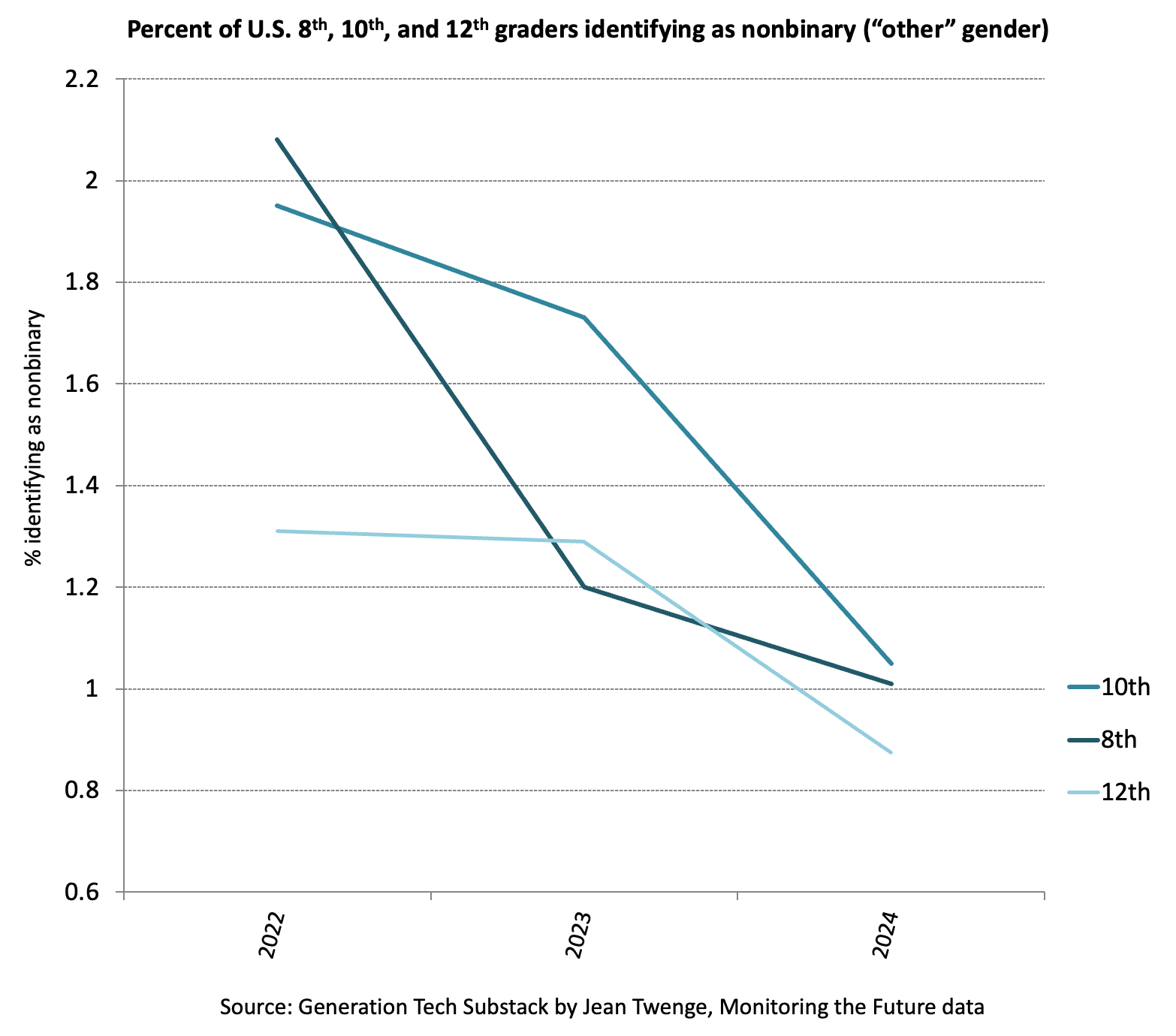
Figure 1: Percent of U.S. 8th, 10th, and 12th graders identifying as nonbinary (“other” gender), 2022-2024
Thus, identifying as nonbinary is not just in free fall among young adults -- it’s also in free fall among teens as young as 13. It’s not just in free fall among elite college students – it’s also in free fall in nationally representative samples of middle and high school students.
The decline was largest among 8th graders; identifying as nonbinary was cut in half between 2022 and 2024, with most of the decline between 2022 and 2023. The change happened a little later among 10th graders, with most of the decline occurring between 2023 and 2024. Among 12th graders, there was no significant change between 2022 and 2023 and then a decline in 2024; they also began with a lower rate in 2022.
This pattern is an almost perfect illustration of a generational shift, starting earliest among the youngest group and then moving up the age scale.
With three nationally representative samples showing a decline in transgender or nonbinary identity since 2023, it’s clear things have shifted just in the last few years. And now we know the change isn’t just among young adults – it extends to even the youngest teens.
Praise Jesus, sanity is returning!
And now to the real question: what's changed?
Good!
Typo? "The results were unambiguous. Across all three grade levels, identifying as nonbinary plummeted between 2022 and 2014"
2014 -> 2024?