

Last week, we got some of the worst news yet about standardized test scores for U.S. K-12 students: Not only are they declining, but the decline started in 2013 – not during COVID – and has touched almost all states.
The analysis was from Education Scorecard, a Stanford and Harvard research collaboration. The report concludes that the “learning recession” began around 2013. Figure 2 is really stunning:
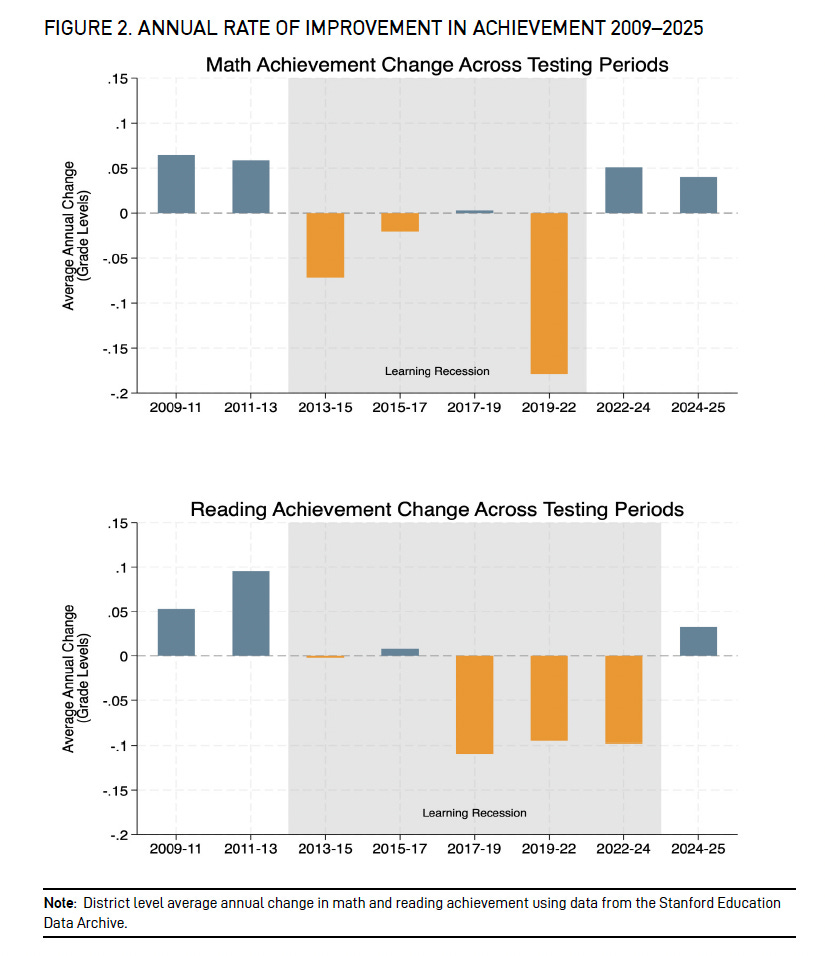
The declines (orange bars) for reading (lower graph) are especially striking, because the declines were nearly equal 2017-19 (before the pandemic), 2019-2022 (during the pandemic) and 2022-24 (pandemic recovery). Only from 2024 to 2025 was there any post-pandemic recovery, and it paled in comparison to the large declines since 2013. Clearly this is not just COVID — something else is going on.
On X, I posted a figure from the New York Times story covering the report and the declines in reading scores, which show up in nearly every state:
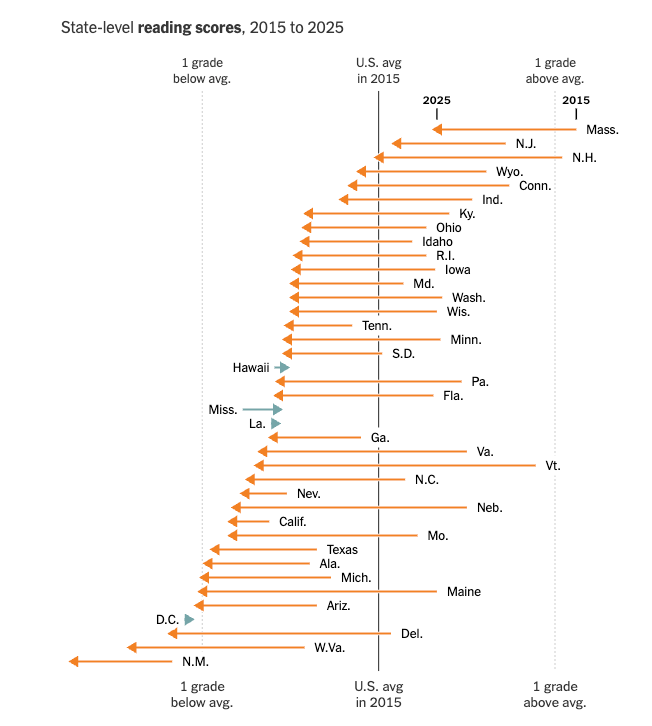
This graph is especially tragic because it shows just how large the decline in reading proficiency has been—nearly an entire grade level in many states. It also shows how pervasive the decline has been. This is not a regional problem; this is a national problem. (Except, go Mississippi!)
The question, of course, is why. When I posted this graph, the immediate response from many on X was that the slide in reading scores must be caused by demographic shifts, especially increases in immigration. Here’s a representative example:
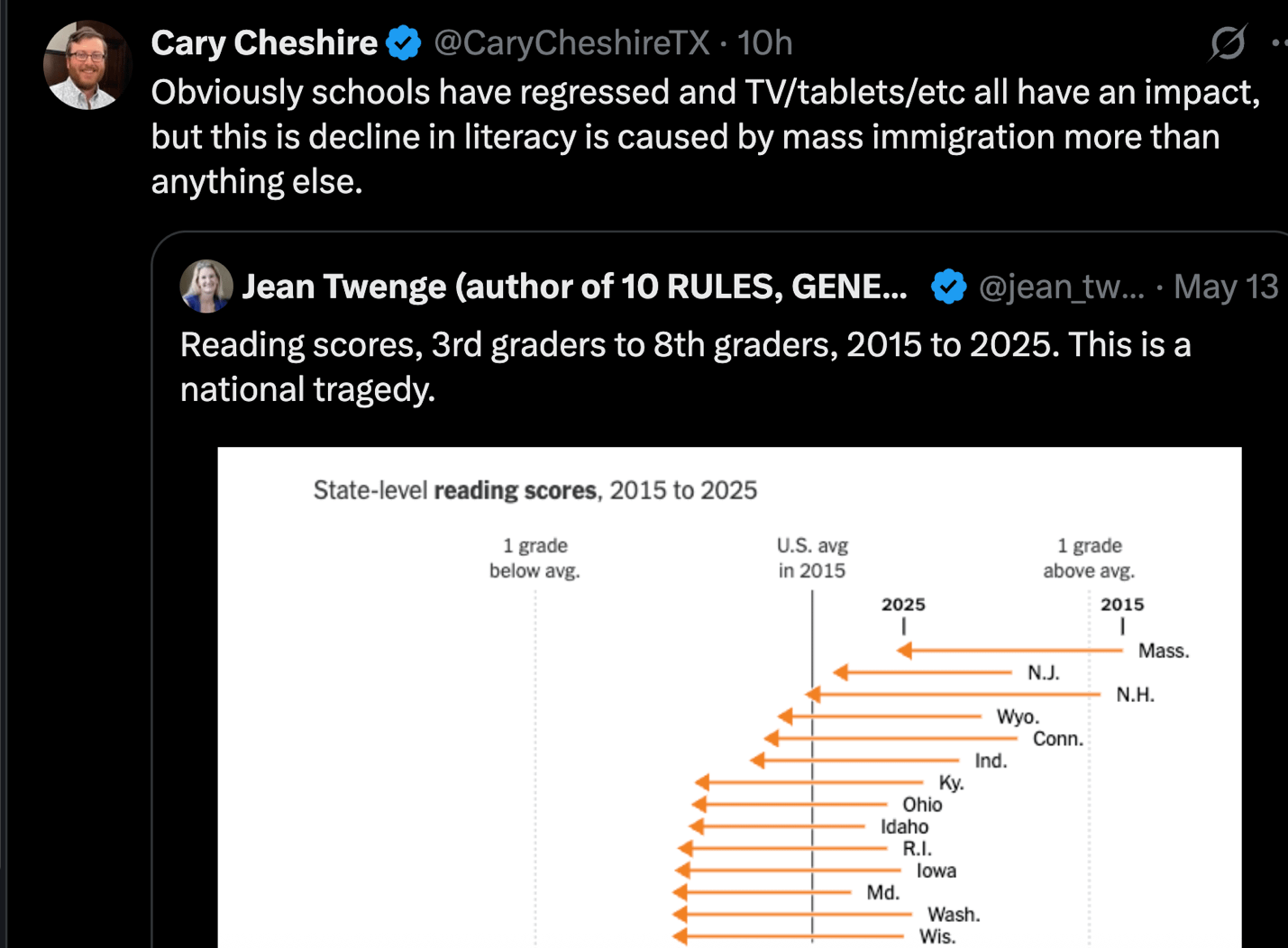
Others posted some variation of “this is what happens when you let in a flood of immigrants.”
If I’m understanding it correctly, the argument is this:
Large numbers of immigrants entered U.S. schools between 2015 and 2025. English wasn’t their first language and/or they came from disadvantaged circumstances, so they did considerably worse on standardized tests of reading, and that’s why reading scores went down so much.
So is that why?
The good news is this theory is testable. We can start with the first assumption, that large numbers of immigrants entered U.S. schools between 2015 and 2025, and go from there.
The data aren’t difficult to find. The U.S. Census has tables showing the estimated number of people who are foreign-born vs. born in the U.S. for those under 18 and over 18 in each year.
Since it’s K-12 students taking the reading tests, the group under 18 is the most relevant. What percentage of those under 18 were foreign-born in 2024 (the most recent data available for this stat)? Answer: 4.36%, or 4 out of 100. Not exactly “mass immigration.”
In 2015, the number was 3.37%, or 3 out of 100. So the number of foreign-born kids in U.S. schools did increase over the decade-long period, but only by one percentage point. Even if we assume that the foreign-born kids performed worse on reading tests –- and that definitely wasn’t true of all of them -- this is too small a shift to explain the dramatic declines in reading scores.
Some might then argue there has been mass immigration of adults who have kids once they arrive in the U.S. If that were true, there would be little change in the foreign-born population of kids, but a large (or at least larger) increase in the number of foreign-born adults.
But that didn’t happen either. The percentage of adults who are foreign-born was 17.61% in 2024 and 16.47% in 2015 – again, a one percentage point increase. There was no “mass immigration” of kids or adults between 2015 and 2024. There was an uptick, but it’s far too small to have caused a grade-level decline in reading scores in nearly every state.
So if immigration is not the reason, what did cause the decline in reading scores?
Certainly the pandemic school closures are responsible for some of it. But, since the declines started in 2013, COVID is clearly not the whole story. The report’s authors conclude that the Obama administration’s scaling back of George W. Bush’s No Child Left Behind (NCLB) program may be partially responsible, as NCLB held schools more strictly accountable for student achievement.
The authors also write, “The decline in achievement which preceded the pandemic was likely partially due to social media exposure.” The timing lines up: Daily social media use soared in popularity beginning in the early 2010s, and became more algorithmic throughout the decade. Social media and other digital media – whether it’s on a phone or a laptop, even a school-issued laptop -- distracts students in class when they should be learning. It’s tempting to think school-issued devices block access to anything but educational resources, but sadly that is not the case. Many can access YouTube, streaming services, even pornography.
Social media is also distracting at home, when scrolling through TikTok is easy and doing your language arts homework is hard. With so many digital distractions, kids and teens are also not reading for pleasure. Even high school English teachers have given up assigning books.
On X, many blamed American education in general. But, as the report emphasizes, reading scores were actually improving between 1990 and 2013. So the educational system was doing a great job until about 10 years ago. (The figure below also shows the implementation of NCLB and the later law, ESSA, which eased up on accountability).
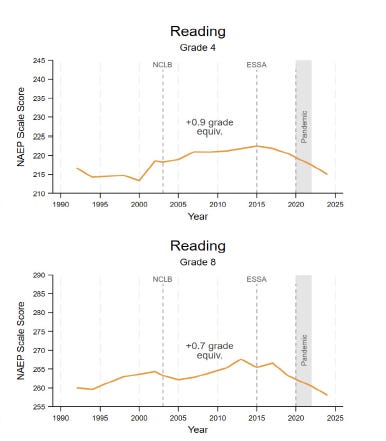
I agree with the authors of the report that social media played a role and that we should be researching the effects of school phone bans. But the problem is bigger than that. There are at least two other changes that would help:
1. Parents should delay giving their kids smartphones until at least high school, preferably until after they get their driver’s license. Until then, get them a flip phone or a basic phone designed for kids, and lock it down to just a few apps. And don’t even get them this until they absolutely need it – parents often get their kids phones so they can reach them. Then their kid does everything on the phone except call their parents. I go over a detailed plan for how to do this in my book 10 Rules for Raising Kids in a High-Tech World.
2. Schools need to stop handing out tablets and laptops to students, especially elementary school students. In middle school, have shared devices at school and don’t send them home. Parents have had it with school-issued devices that their kids use to watch YouTube and streaming when they are supposed to be doing their homework and with classrooms where kids watch videos all day.
But won’t this mean that kids aren’t learning computer skills? Not really. Watching videos is not teaching them computer skills; it’s training their brains to not be able to pay attention to anything longer than 10-20 seconds. They do need to learn how to type, but they can do that in high school – and with AI dictation, they may not even need typing skills by the time they get to the workplace.
But there are some things students do need for college and long-term success: The ability to focus, think critically, and understand complex ideas. Devices undermine each of those. Books teach them all.
As a psychotherapist, I am increasingly hearing from parents that they wish their kids were not provided with chrome books. They are aware that the kids find ways of getting through the controls the schools may have installed and accessing content that is not connected to learning.
But parents also express great concern about their kids’ attention spans and their lack of interest in reading, as well as the distractions that come from schools full of smart phones. I encourage my clients to get involved at the school or the school district level, advocating for no phone access during school hours, backing off of chrome book use, and educating parents about the negative impact of excessive smart phone use and the dangers of social media. If this is a larger effort, their own children are less likely to be in a position of feeling like the odd one out if they have restrictions their peers do not.