

We’ve known for a decade that clinical-level depression, self-harm, suicidal thoughts, and suicide rose among adolescents after 2011.
We also know that the more time a teen spends using social media the more likely it is he or she is unhappy, low in life satisfaction, or high in symptoms of depression.
There’s a bit of a difference, though: The studies of change over time have shown increases in mental health issues that require treatment, while the studies among individuals mostly focus on low psychological well-being or symptoms of depression measured by questionnaires. This difference has led some to argue that there is no evidence of a link between social media use and mental health disorders that require treatment.

I’ve always been skeptical of this argument given the strong links between self-report well-being or symptom measures and mental health disorders; the self-report measures correlate strongly with clinical diagnoses and are often used to screen for mental health disorders. It’s pretty unusual to find someone with major depression who says they are happy and doing well.
Still, having data showing a link with mental health disorders would be even better. That way, we’d know for sure that social media use was associated with actual mental health disorders – the type that require treatment – not just with unhappiness, low life satisfaction, or elevated symptoms of depression.
My colleagues and I have done a few of these studies. We found a link between social media use and self-harm behaviors in a large sample of UK adolescents, though self-harm was measured via self-report. We also found that digital media use was linked to depression, self-harm, and suicidal thoughts according to clinical criteria among 9- to 10-year-olds in the U.S. in the ABCD dataset. However, social media use was low in this very young population.
Ideally, we’d want a large sample of adolescents with clinically diagnostic measures of mental health disorders as well as a solid measure of social media use. A study that came out last year (Fassi et al., 2025) does just that …
… and it finds an even larger link than studies using well-being measures.
Teens with mental health conditions including generalized anxiety disorder, major depressive episode, eating disorders, oppositional defiant disorder, or ADHD spent more time on social media than those without a mental health condition, g = .46. That means teens with mental health conditions spent nearly a half a standard deviation more time using social media. That’s equivalent to a linear r of .22, almost exactly what another dataset showed for social media time and self-reported depressive symptoms among girls (r = .24).
For teens with internalizing disorders like anxiety or depression – the clinical-level equivalents to low well-being or high depressive symptoms – the effect size was even larger, g = .62. That’s a linear r of .30, higher than any study I know of that looked at social media time and well-being or depressive symptoms.
There were other differences between those with and without mental health disorders as well. Teens with internalizing disorders were also more likely to experience social comparison on social media (feeling they don’t measure up to other people’s profiles or photos), feel a lack of control over the time they are spending on social media, and report a bigger impact of social media feedback on their moods. Even those with externalizing disorders (like conduct disorder) spent more time using social media than those without any mental health disorder.
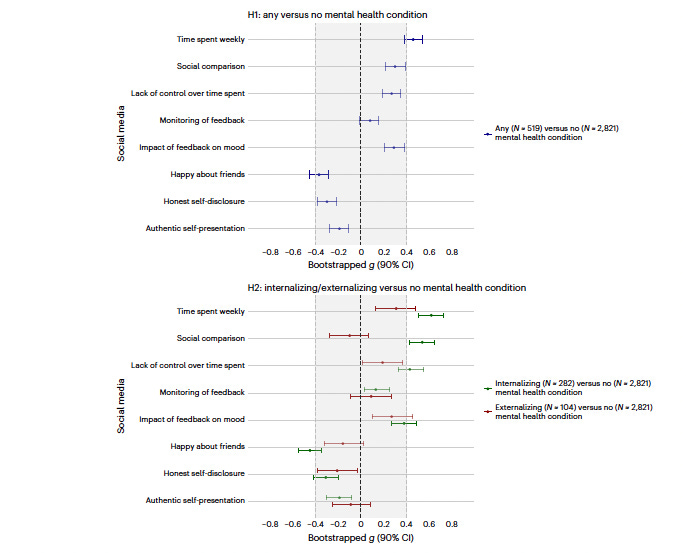
Above: Selected figures from Fassi et al. (2025)
This dataset still has more to tell us. For one thing, Fassi et al. did not control for sex. That’s very odd, as girls both spend more time on social media and are more likely to have internalizing disorders. The overall effect sizes may be somewhat lower since they didn’t include that control. The set-up of the analyses, comparing estimated social media time in each group, is strange – in my view, it would be better to see the percentage of teens with a mental health disorder at each level of social media use. The gray shading in the figures above does not indicate statistical significance; instead, they reflect g = -.40 to .40, which the authors of the article (pretty arbitrarily) designated as the “smallest effect size of interest.” Given that childhood lead exposure and adult IQ is g = .22, a g of twice as much is going to leave out many important and meaningful effects. Nevertheless, social media time was above their very high threshold.
This study puts to rest the idea that mental health conditions are not associated with social media use. They are, and at an even higher level than measures of well-being or depressive symptoms. That is further evidence that increases in major depressive episode and self-harm among teens after 2012 are linked to the rise of social media and smartphones. Combined with the two recent meta-analyses showing that social media reduction improves depression and well-being, this study is yet more evidence pointing toward severely limiting social media use among adolescents.
Dr. Twenge, Thank you for bringing real research to this subject. As noted in the Journal of Affective Disorders article, "Digital media-related precursors to psychiatric hospitalization among youth," kids' issues with smartphones and social media are a key reason involved in a high number of psychiatric hospitalizations. Attempt to set limit on an adolescent's social media or phone and responses involving suicidal behavior are highly common.