

As countries around the world consider social media bans for kids under 16, the question has come up again: Is the teen mental health crisis confined to the U.S., or is it international?
There are many reasons to support a social media ban that have nothing to do with mental health. Many parents don’t want their kids using TikTok at 2am, buying drugs or exchanging explicit photos on Snapchat, or comparing themselves to the perfect bodies on Instagram. There are also many reasons to care about the teen mental health crisis apart from the role of social media.
But understanding the scope of the mental health crisis is useful for knowing where teens are suffering more than in generations past and for determining the cause of the crisis. If school shootings were the primary driver of the teen mental health crisis, for example, we would expect depression, anxiety, and suicide to rise in the U.S. but not in countries without the same level of school violence. The same goes for other U.S.-specific explanations, such as the opioid epidemic.
We already have solid data from many sources that anxiety, low life satisfaction, emotional distress, poor mental health, and loneliness have increased among adolescents and/or young adults in many countries around the world.
But what about suicide rates? Critics have often argued that suicide data, in particular, do not fit the narrative of an international crisis in youth mental health. In his review of The Anxious Generation, for example, Tobias Dienlin writes, “the mental health crisis Haidt describes appears to be more specific to certain regions, particularly the United States, rather than a global phenomenon. Data from large-scale international sources show no consistent decline in youth well-being (Marquez et al., 2024) or suicides (Michalek et al., 2024). This discrepancy suggests that the mental health issues Haidt highlights are influenced by regional factors rather than being universally applicable.”
As we’ve already covered, youth well-being is indeed down (including in most of the datasets discussed in Marquez et al., 2024, the report Dienlin cites). And the source he cites for suicides uses the Global Burden of Disease database, which relies on estimates rather than actual data.
What happens if researchers look at actual suicide data, not modeled estimates?
Several articles published in the last year have taken a more detailed look at suicide rates in many countries across the globe. These analyses have taken two steps that many previous analyses did not: 1) they gathered actual suicide mortality data instead of using the Global Burden of Disease or WHO Global Estimates and 2) they report suicide rates broken down by gender and age group. This is crucial, since the rise of social media impacted teen girls and young women the most; looking at overall suicide rates isn’t good enough.
A caveat: More than other mental health indicators, suicide rates can be influenced by many factors outside of teens’ everyday routines and relationships, including access to firearms, the availability of mental health treatment, and suicide prevention programs and helplines. There are also cultural differences and events unique to certain countries or regions. Thus, we wouldn’t expect suicide rates to show exactly the same trends in all countries. If we can discern a pattern, though, it’s worth paying attention to, as suicide is the most tragic outcome of poor mental health. From a methods standpoint, suicide rates are the mental health indicator least likely to be influenced by self-report issues.
To try to find as many relevant articles as possible, I searched all EBSCO databases (including Medline and PsycInfo) for articles published in the last year with “suicide” in the title and the words “youth” or “adolescents” and the word “trend” anywhere in the article record. I focus here on articles presenting suicide data on adolescents and young adults from Europe and Asia; in a future post I’ll cover four English-speaking countries (England and Wales, Australia, Canada, and the U.S.). I’m most interested in data from 2010 to the present, given the rise of social media during that time period.
Let’s start with Spain. Below is the authors’ graph of suicide rates by gender (males on the left, females on the right) and age group.
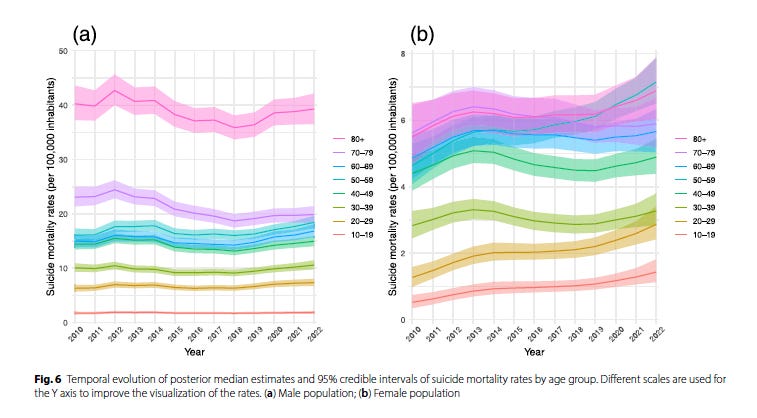
Not much happens for the male suicide rate among adolescents (10-19, red line) or young adults (20-29, orange line), though there is an uptick among young men since about 2018. But check out the graph for females, on the right: Suicide rates nearly double among 10- to -19-year-old girls and increase even more among young women in their 20s. The increase for young women is so large it comes close to equaling the suicide rate for women in their 30s.
Another article looked at suicide rate trends across Europe. (This article uses the WHO Mortality Database, which is different from the WHO Global Health Estimates; the authors specifically say they relied only on official statistics). For male adolescents or young adults, they find increases from 2010-2014 to 2020-2022 in Italy, Spain, and the UK in their country-specific analysis and in North Europe in their regional analysis. That’s still noteworthy, given that these are places without the U.S.-specific issues, such as school shootings, often mentioned as a cause of the adolescent mental health crisis. But in many European countries, the suicide rate for teen boys and young men has not increased.
For girls and young women, however, the authors find increases from 2010-2022 (the green bars) much more broadly. Below is their graph for trends in the suicide rate for females by region:
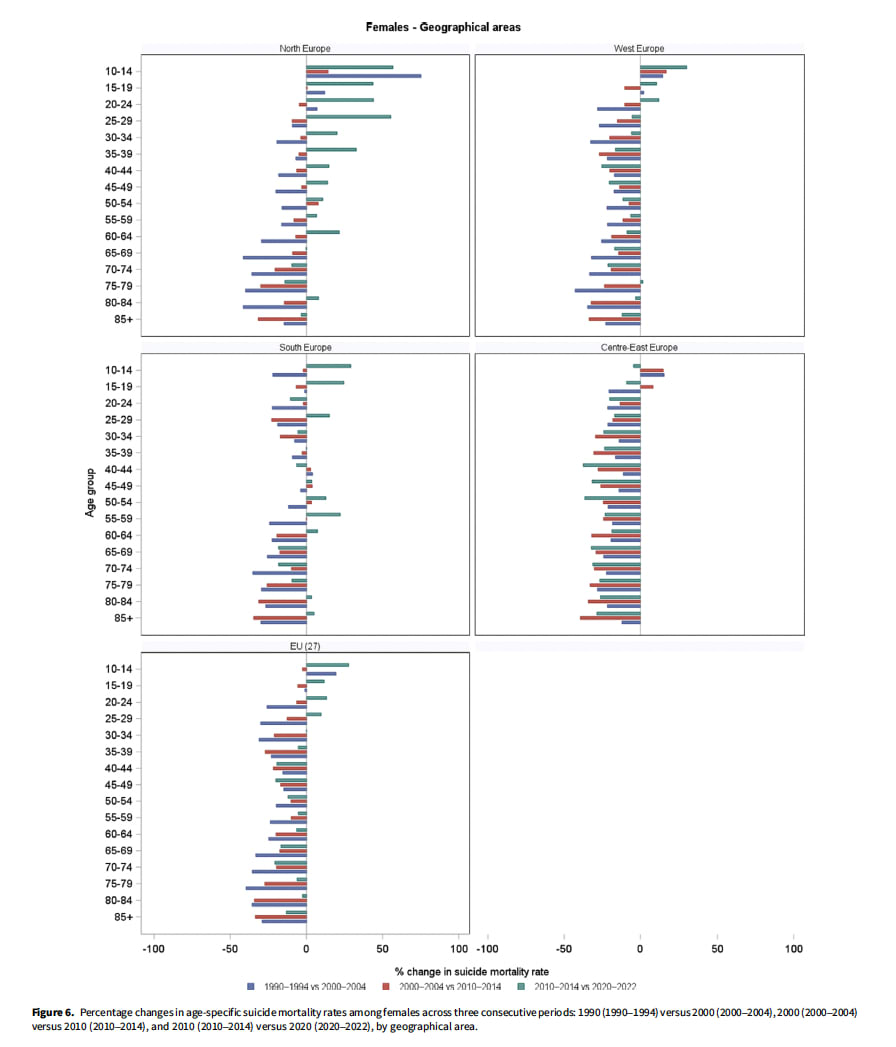
The green bars head to the right (indicating an increase 2010-14 to 2020-22) among all three adolescent and young adult age groups (10-14, 15-19, and 20-24) in North Europe (which includes Denmark, Finland, Iceland, Ireland, Norway, Sweden, and the UK). And the increase is not small – it’s around 50 to 75%. There are also increases in the female suicide rate in all three of these age groups in Western Europe (Austria, Belgium, France, Germany, Luxembourg, the Netherlands, and Switzerland) and the EU as a whole, and in two of the three age groups (10-14 and 15-19) in South Europe (Greece, Italy, Malta, Portugal, and Spain). The only region without increases is Central/East Europe (e.g., Czech Republic, Hungary, Romania, Serbia).
And here is their graph for country-specific analyses for females:
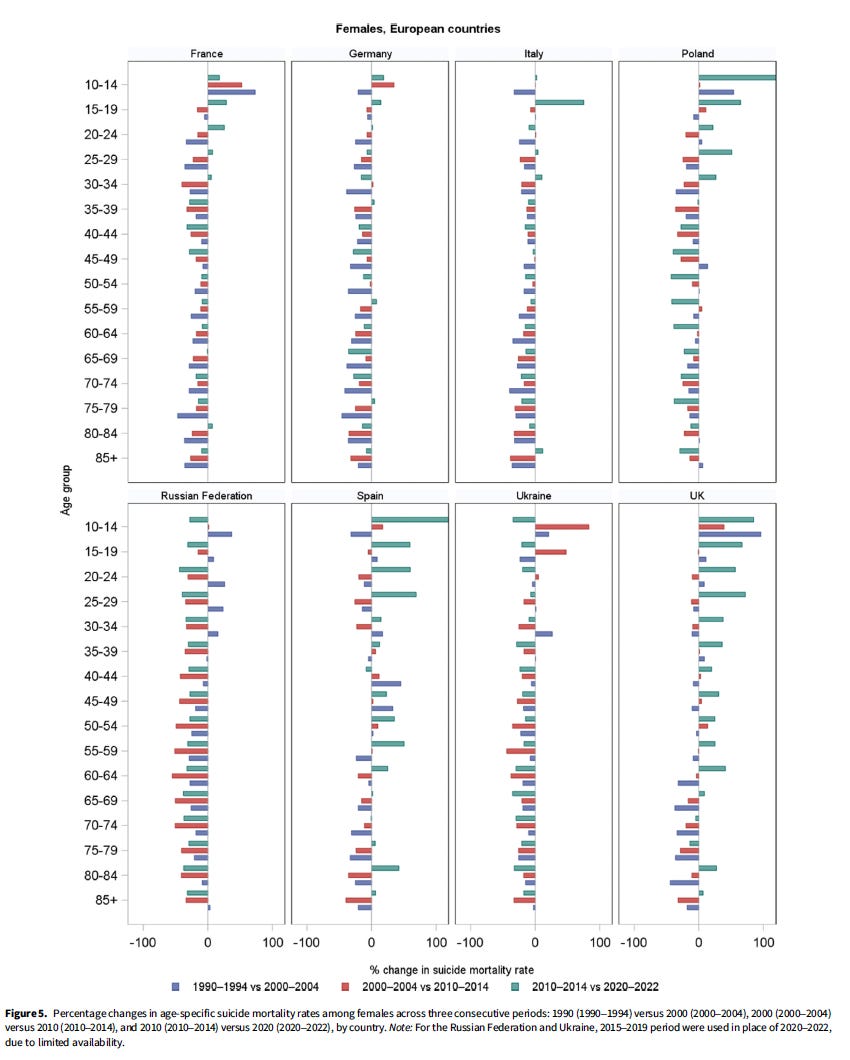
The green bars are on the right (indicating an increase in suicide rates) for all three age groups (10-14, 15-19, and 20-24) in France, Poland, Spain, and the UK, and are on the right for adolescents (10-14 and 15-19) in Germany and Italy. Russia and Ukraine instead show declines. So in 6 out of 8 countries, the suicide rate for teen girls is higher than it was in the early 2010s.
I’ll move next to Asia. I was all set to include an analysis of suicide data from Japan until I saw they got their data from the Global Burden of Disease dataset – and thus used estimates, not actual data. But I did find an article reporting actual suicide data from South Korea. The authors even provided a supplement with the numbers by age group, gender, and year, which meant I could graph it myself. Here is the suicide rate for 10- to 19-year-olds in South Korea since 2010:
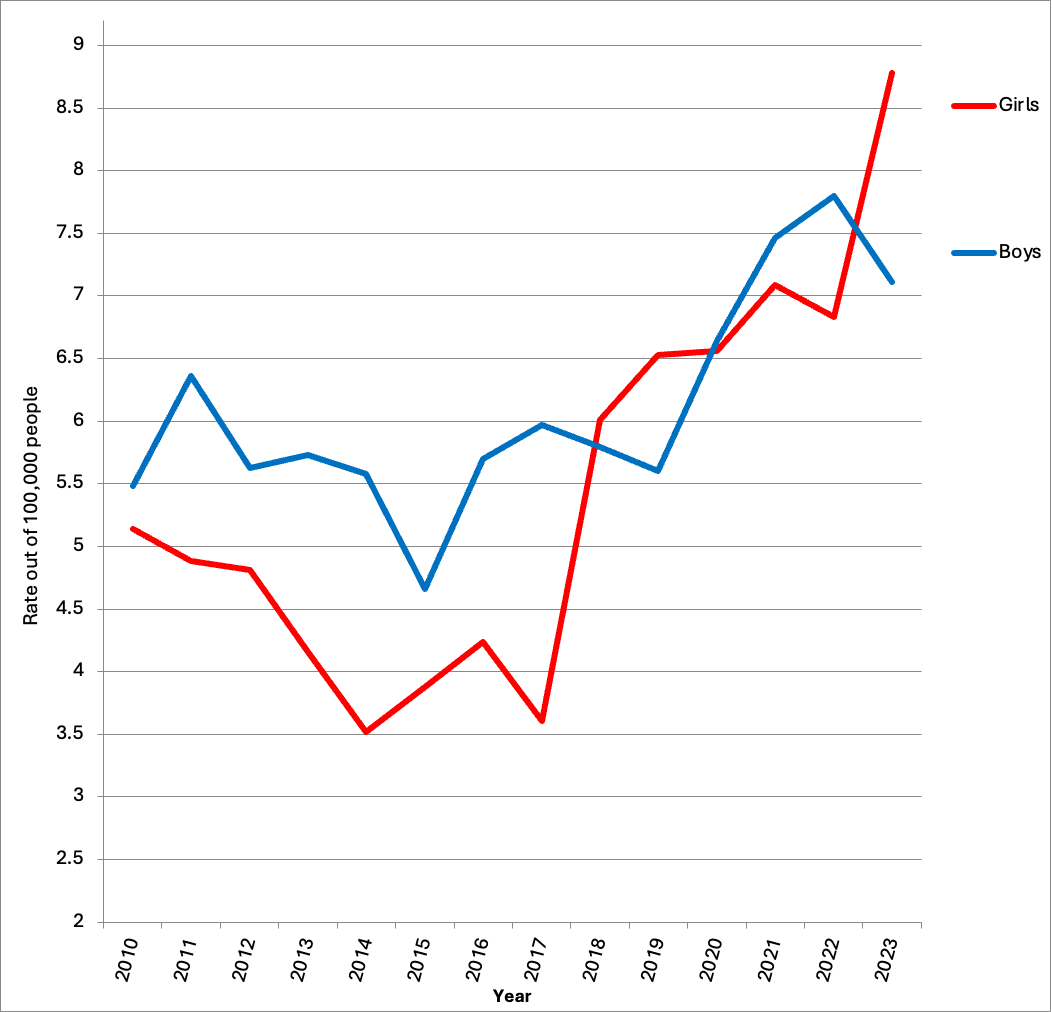
Figure: Suicide rate for 10- to 19-year-olds, South Korea, by gender. Source: Oh et al., 2025
For boys, the suicide rate was 30% higher in 2023 than it was in 2010, though the largest increase was between 2020 and 2022, suggesting COVID might play a role. For girls, the suicide rate in 2023 was 71% higher than it was in 2010, with little change during the peak COVID years of 2020 and 2021. Instead, the largest upticks were between 2017 and 2018 and 2022 and 2023.
The trends here are clear: The suicide rate for teen girls has increased since 2010 in most countries and regions in Europe and in South Korea. These are regions that experienced the rise of smartphones and social media just as the U.S. did but did not have regular highly publicized school shootings or lockdown drills. They also didn’t have a widespread opioid epidemic or the same trends in income inequality or politics that occurred in the U.S. Any U.S.-specific (or English-speaking-specific, or even Western-specific, given South Korea) explanation doesn’t work for these data.
As I noted earlier, many factors impact suicide trends. But combining this data with with the raft of evidence on increases in depression and low well-being among teens across many countries strongly suggests that the adolescent mental health crisis is international, particularly among girls. That means the cause is likely to be something that is also international.