

Introduction from Jean:
One of the best parenting books I’ve ever read is Michaeleen Doucleff’s Hunt, Gather, Parent. She visited cultures around the world to see how they raise their kids, and came away with a startling but effective idea: Why not involve our kids in the work of the family instead of kids being the work of the parents? It really informed my thinking when I was writing 10 Rules for Raising Kids in a High-Tech World.
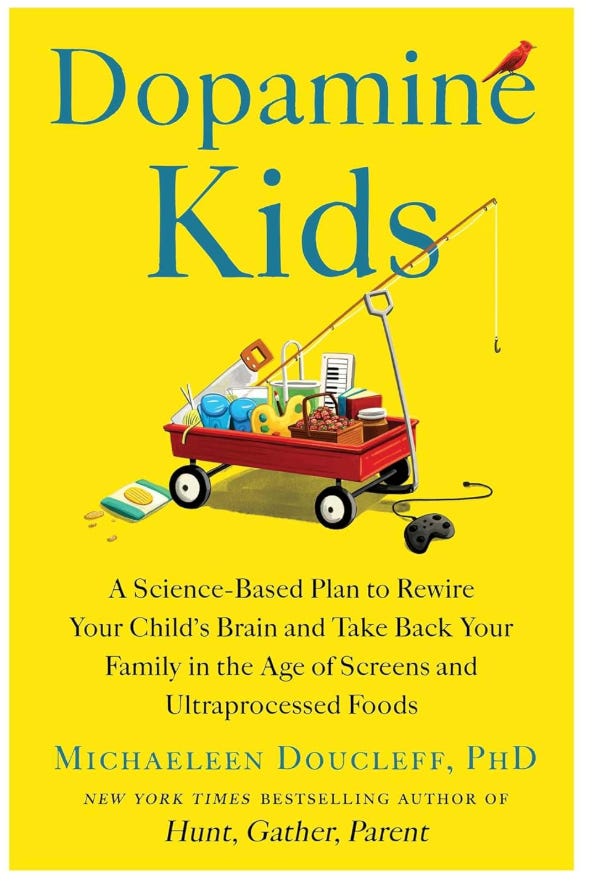
Now Michaeleen, who’s a science reporter at NPR, is out with a new book, Dopamine Kids. I devoured it, and I think you will too. Even better, you’ll learn things that will help your parenting. (I know I’ve been guilty of Mistake #2, below!) Please enjoy her guest post, below, and feel free to share it.
Five years ago, I decided to finally fix a long-standing issue: my phone addiction. At age 44, I had a severe problem.
I was so obsessed with my phone that I could no longer enjoy quiet, relaxing moments with my daughter, Rosy. One afternoon, I sat on a beautiful beach near San Francisco, watching Rosy try to build a crumbly sandcastle. She hummed along contentedly as she dug a little moat for the castle. But all I could think about was checking my emails, my texts, and social media accounts. I drew my phone from my pocket, swiped at each app, and then a few minutes later, I’d pull out my phone and launch the same circuit over again.
Inside, I could feel this low, constant hum of anxiety churning in the back of my mind. It felt like a continuous wondering of What’s next? What’s next? What’s next?
I knew my phone obsession affected Rosy and that eventually I would pass my habit onto her. And how could I protect her from the pitfalls and perils of a digital life if I didn’t fix my own problems first?
So I set out on a mission: to figure out why I couldn’t stop thinking about my phone—and use that knowledge to break my addiction.
I read hundreds of studies and interviewed dozens of psychologists and neuroscientists. And eventually, after a few years and a bunch of experimentation, I not only broke my habit; I crushed it. My average phone time now stays well below 15 minutes each day. My sleep improved beyond belief. I’m a happier person—much happier.
In my new book Dopamine Kids, I describe how I did it and how I successfully weaned Rosy off screens, as well. Throughout the process, I discovered something surprising: parenting advice around phones and screens is woefully outdated. It’s based on research that’s 20 to 30 years old. And it doesn’t work well.
As a mom, I was making a few big mistakes with screens and my daughter—mistakes that made regulating her screen time a hard and continual struggle. Once we fixed these errors, limiting screens actually became fun. And in the end, it meant adding more joy and pleasure into our lives.
Mistake No. 1: Screen time = pleasure time
For years, I struggled to limit my phone use because I didn’t want to decrease the amount of “pleasure” in my life. I believe that I spent hours and hours each night, cuddled up with my phone and scrolling in the dark because social media was my “reward” or “treat” at the end of a stressful day. It was my key source of pleasure.
At the same time, I believed that my daughter spent hours watching cartoons on Netflix or YouTube for the same reason: these apps gave her a continual drip of dopamine, and these surges fill her with joy and happiness. (Dopamine is the molecule of happiness and pleasure, right?)
Therefore, I always felt really bad limiting screen time with her—or with myself. I felt like a mean mom, dedicated to stripping away from her only daughter the very activities that she loved more than anything else in the world. Why would a mom do that? And why would a mom do that to herself?
Limiting screens seemed like settling for less pleasure in life. Neuroscience from the past 30 years tells us that this thinking isn’t quite right. In some instances, it’s simply wrong.
Over the past several decades, scientists have accumulated a massive amount of evidence showing that dopamine’s critical role in our brains isn’t giving us pleasure but rather ensuring our survival—to make sure we want, seek out, and obtain what we need to stay alive. And it does that by triggering the feeling of wanting or desire, neuroscientist Kent Berridge explained to me one afternoon at his office at the University of Michigan. It motivates us and gives us a willingness to work.
But it fuels repeated desires. A surge of dopamine tells you to do something now … and then do it again when you can. Press the button again. Comment again. Scroll again. Check again. Dopamine makes you want, over and over again. Dopamine drives obsession.
The “dopamine-is-pleasure hypothesis” is wrong, says Berridge, who has led the way in untangling dopamine’s complex role in our brains. And here’s the critical part: Although most of the time, we want what brings us pleasure, in modern life, we have activities and foods that split up this beautiful synchrony, Berridge says. We can want—even intensely crave–activities that hurt us.
Take, for instance, teenagers and social media. In one study, published in 2022, some teenagers said that social media caused them to feel depressed, and yet they still wanted to use it. They still had to login. “I have repeatedly deleted Instagram in an effort to improve my emotional state but then, I reinstall. Many times,” one teenager told the scientists.
I had a similar experience with social media. Many times I felt worse after I checked my accounts. I would leave social media with a sense of insufficiency, unworthiness or even anger. And yet I would choose using social media over enjoying the beach with my little girl.
This better understanding of my dopamine system empowered me to quit social media, but it also emboldened me as a parent. I began to see my daughter’s obsession with Netflix and YouTube quite differently. I could see all the ways that screen time didn’t bring Rosy pleasure but rather how it triggered an intense motivation in her that, over time, grew frustrating, uncomfortable, and even stressful for her.
So I realized that limiting her screen time—or even getting rid of it—wasn’t depriving Rosy of pleasure, but it was actually a chance to reclaim pleasure in our lives. But before we could do that, I had to stop making mistake No. 2.
Mistake No. 2: “Please, put down the device and go … read a book”
For years, whenever I tried to limit Rosy’s screen time, I replaced scrolling with … well, very little. I’d tell her to go “read a book” or “play outside.” To her, these ideas seemed about as exciting as me saying, “Put down the screen and go be bored” (because she would literally tell me that. “But that’s boring, Mom,” she would whine).
Honestly, a part of me thought that she needed to be bored. Parenting experts and psychologists had often advised me to take this strategy. “Let Kids Be Bored. It’s Good For Them,” a New York Times headline read in 2023.
As I learned more about the science of screens and talked with behavioral psychologists, I realized, Oy! I’m making a huge mistake.
“No, no. It’s not about being bored,” says neuroscientist and psychologist Mateusz Gola at the University of California, San Diego. “It’s about having more excitement [in your life], not less.”
For decades studies have shown that boredom doesn’t typically spark creativity or prompt us to go seek out friendships, as often believed. But instead, it’s associated with an array of problems, including unhealthy eating, attention problems, depressed feelings, frustration, and even political extremism.
In our age of devices and apps, boredom doesn’t work, Gola says. Modern video games, video streaming, and social media apps offer an endless and rapid-fire supply of surprising, edgy, and evocative content. If we suddenly switch to a void of nothingness—or what feels really boring by comparison—we create a horrible discomfort in our brains and bodies. For me, it felt like standing in a cold shower, shivering, as icy droplets of water slid down my back. Time would go by so slowly. And I was stuck there naked and cold. I hated being bored, and I wanted out. What had always been my out? My phone.
So instead of boredom, what does work: Replacing screen time with something that’s (almost) just as exciting and (almost) just as interesting to your child, says behavioral psychologist BJ Fogg at Stanford University. “You have to find something the child already desires. This is the key to lasting change.”
Find activities that light up your child’s dopamine systems and send their motivational juices flowing, Gola says. “So for me, I replace my phone with extreme sports, like paragliding and surfing. These are not boring.”
Clearly, most kids can’t go surfing or paragliding. But kids don’t need that level of danger. For children, including tweens and teens, excitement and motivation comes from simply having more autonomy in life, tackling manageable risks and honing adult skills. For example, Rosy wanted to learn to ride her bike to the market alone so she could buy gum and run errands for the family. She also yearned to use the oven so she could bake on her own. And she had shown interest in learning to make clothes with a sewing machine, because that needle is sharp, and it’s moving fast. It feels dangerous and exciting to Rosy.

So before I limited screen time, I started to help Rosy cultivate these hobbies and help her experience the joy and pleasure of developing these skills. Then when I finally had enough courage to cut out Rosy’s Netflix habit completely, I didn’t need to leave her empty-handed or bored. I had a whole menu of exciting and fun activities that she already knew that she enjoyed. And if she still complained, I had what I think of as the methadone of Netflix: audio books.
Finally, to ensure screens and apps didn’t creep back into our lives, I had to fix one more mistake.
Mistake No. 3: I’ll build up Rosy’s willpower so she can regulate her own screen time
Willpower is the ability to resist a temptation that’s readily available to you. “So the idea of effortful resistance,” says psychologist Marina Milyavskaya at Carleton University, in Ottawa, Canada.
“Fifteen to 20 years ago, it was thought you could train willpower,” she says. So parents could strengthen a child’s willpower, like a muscle and teach them over time to regulate their own screen time. For example, if I let Rosy watch YouTube each day, I can teach her to stop watching after an hour (and to resist her device at every other moment).
“There’s really not a lot of evidence showing that this strategy works, and none that I know of with kids,” Milyavskaya says. Instead, I was simply creating an entrenched habit and boosting her desire for YouTube, says Michael Inzlicht, a professor of psychology at the University of Toronto.
As I explored in a piece for NPR in March, research over the past 15 years suggests that willpower doesn’t work with modern temptations, especially in the long-term. Studies have found that relying on willpower to resist daily temptations only leaves young adults feeling depleted and less likely to achieve their goals. As psychologist Wendy Wood at the University of Southern California points out, “grown-ups don’t have that much self-control, and certainly kids don’t either.”
Instead of relying on kids’ modicum of willpower, Wood says, set up your home and routine so kids don’t have to resist temptations. Set up times and spaces in kids’ lives in which the offline activity is the only choice. “Structure the environment so that certain behavioral options are just kind of the obvious ones. And other ones aren’t available,” Woods advises.
For example, when we finally put an end to Rosy’s nightly screen habit, I didn’t simply place her devices in a drawer and tell her that they weren’t available. Instead, I hid them—-and hid them extremely well. I placed them in the dryer. And I left them there until Rosy created strong, new habits after dinner.
When screen activities became utterly unavailable to her, Rosy started to enjoy and love offline habits much faster than I had anticipated. And these new activities stuck and became habits. Two years later, she zips around town with her friends for hours at a time. She bakes up a storm, including lasagnas for dinner and breads for breakfast. She not only sews, but also crochets and does crafts.
<<>>
By shifting our mindset around screens and learning strategies that work with our neurology instead of against it, I truly believe we can all break our obsessions with technology, no matter our age. And we can do it in a way that doesn’t trigger tantrums and tears, but rather brings more fun, excitement and pleasure into our lives.
