

In the early 20th century, it was unusual for married women – especially White married women – to work outside the home. The number of women working for pay increased in the 1950s, but women’s work was often part-time, underpaid, or both. Less than 10% of lawyers were women; when future Supreme Court justice Sandra Day O’Connor graduated at the top of her Stanford Law School class in 1952, no law firm would hire her (at least as an attorney; one offered her a position as a secretary). Medical schools routinely capped their enrollment of women at no more than 5% of the entering classes.

Then, from the late 1960s to the 1980s, the number of women business leaders, TV reporters, lawyers, professors, engineers, and doctors shot upward. For several decades, half of newly minted doctors and lawyers have been women.
Laws and attitudes have followed suit. Equal pay for equal work is the law, and rejection of rigid gender roles skyrocketed among American adults between the 1970s and the early 2020s (see Figure 3.22 in Generations).
Questions about equal pay and gender roles have also been asked of teens – specifically, of 8th and 10th graders (ages 13 to 16) from 1991 to 2024. My colleagues and I had previously found that 12th graders’ attitudes toward women working had gotten more positive between the 1970s and 2013. But a lot has changed, culturally and politically, since then. For one thing, 13- to 16-year-olds are often immersed in social media, some of them in the so-called manosphere promoting traditional gender roles (often along with a heavy dose of misogyny; last year, the Netflix movie Adolescence did an excellent job showing the impact of manosphere influencers on young males). Both Trump’s first term (2017-2021) and second term (2025-present) have coincided with a rightward shift in the country. Still, political shifts don’t always show up in real people’s attitudes, and even in this environment it would be surprising if teens were questioning the idea that women should be paid equally for the same work.
But they are.
Or at least more are. Monitoring the Future asks 8th and 10th graders if they agree or disagree with the statement “Men and women should be paid the same money if they do the same work.” From 1991 to 2019, only about 12 to 13% of boys did not agree that women should be paid equally for their work. Then that began to rise. By 2024, the most recent data we have, 22% of boys – more than 1 out of 5 -- did not agree that women should be paid equally for doing the same work as men. That’s an all-time high in the four-decade history of the survey (see Figure 1).
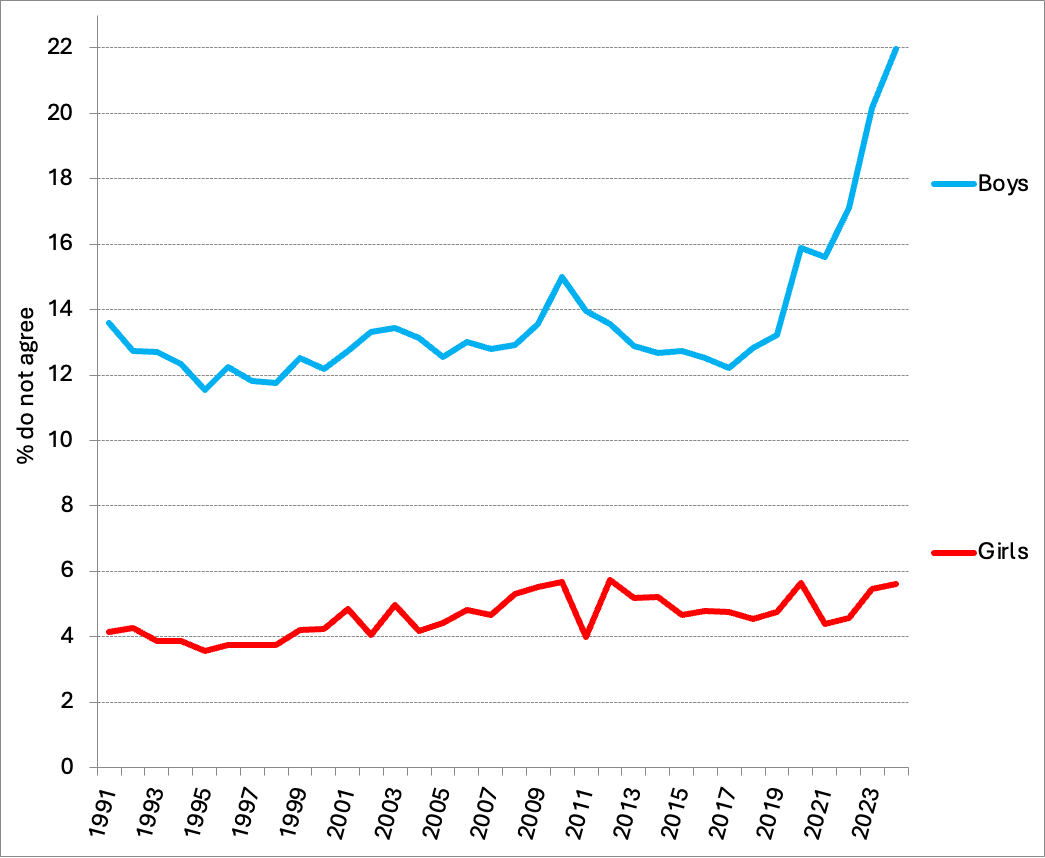
Figure 1: Percent of U.S. 8th and 10th graders who do not agree that women should be paid equally for the same work, by gender, 1991-2024. Figure shows those who answered disagree, mostly disagree, or neither. Source: Data from Monitoring the Future analyzed by Jean M. Twenge for the Generation Tech Substack.
In contrast, only about 5% of teen girls don’t agree women should be paid equally, with no consistent changes over the years.
Teens are also asked if they agree that “A woman should have exactly the same job opportunities as a man.” The number of teen boys who did not agree with this statement declined in the 2010s but then nearly doubled between 2018 and 2024, ending at 3 out of 10 (see Figure 2).
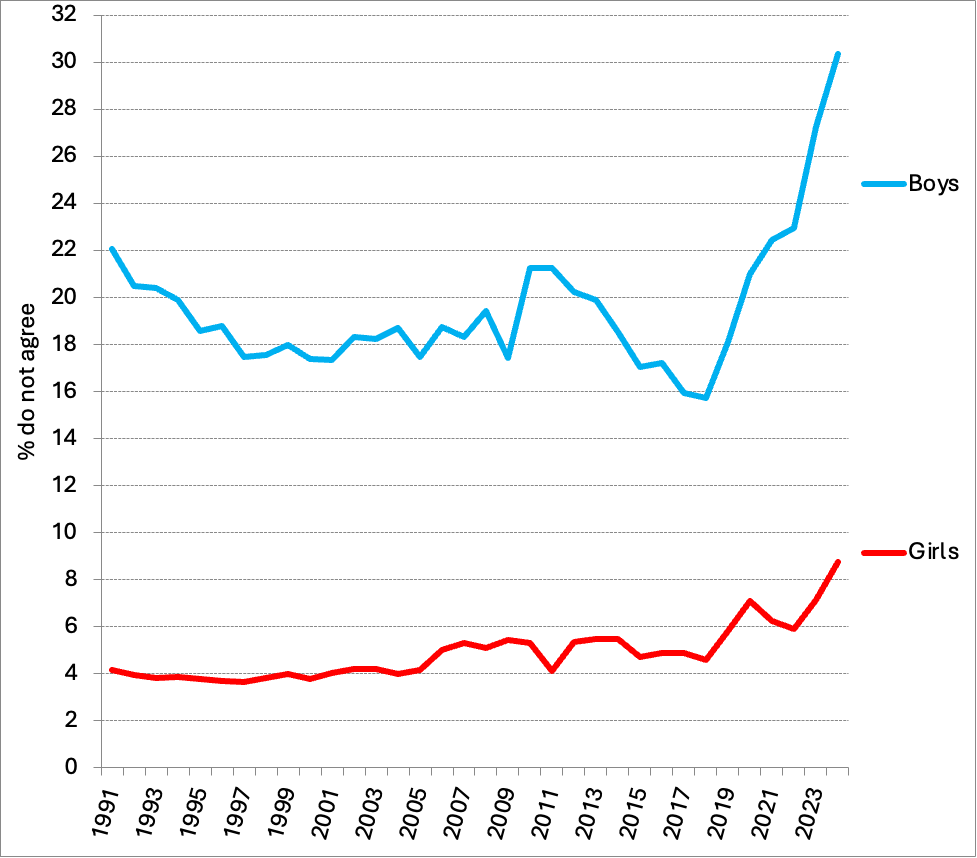
Figure 2: Percent of U.S. 8th and 10th graders who do not agree that women should have the same job opportunities as men, by gender, 1991-2024. Figure shows those who answered disagree, mostly disagree, or neither. Source: Data from Monitoring the Future analyzed by Jean M. Twenge for the Generation Tech Substack.
Even more stunning, the number of girls who do not agree women should have the same job opportunities as men has also risen – not as much as among boys, but enough to amount to nearly twice as many girls in agreement in 2024 vs. 2018.
Then the changes come home. Teens are also asked if they agree “It is usually better for everyone involved if the man is the achiever outside the home and the woman takes care of the family.” This is the kind of rigid gender role division Boomers fought against in the 1970s and Gen X’ers thought they demolished in the 1990s. Previous research up to 2013 found that 12th graders’ agreement with this statement declined an enormous amount between the 1970s and the 1990s, with agreement starting to creep back up in the 1990s.
What happened after that? Agreement with rigid gender roles increased slightly among 8th and 10th graders between the 1990s and 2010s, but then fell from 47% to 32% among boys and from 26% to 13% among girls up to 2021.
Then, in 2023 for boys and 2024 for girls, attitudes suddenly shift again, with 41% of boys and 23% of girls agreeing that it’s best if the man achieves outside the home and the woman takes care of the family (see Figure 3).
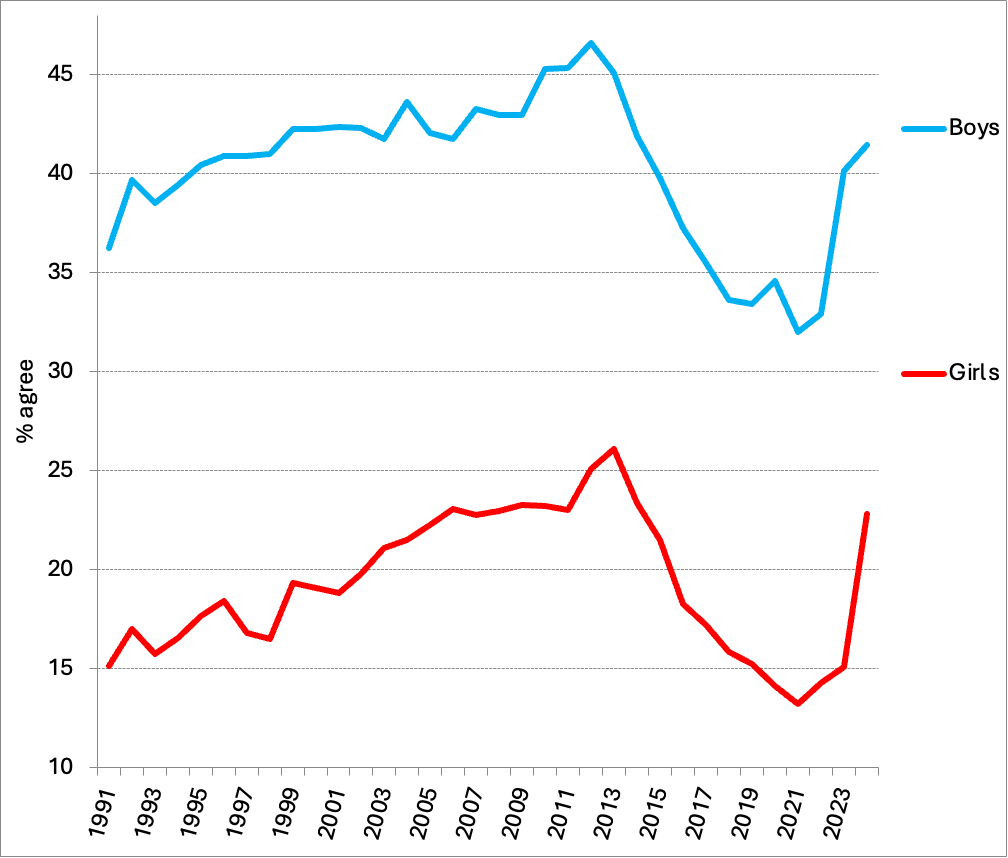
Figure 3: Percent of U.S. 8th and 10th graders who agree it’s best if the man achieves outside the home and the woman takes care of the family, by gender, 1991-2024. Figure shows those who answered agree or mostly agree. Source: Data from Monitoring the Future analyzed by Jean M. Twenge for the Generation Tech Substack.
Unlike the questions on women’s pay and job opportunities, here the shift in attitudes among girls is just as large as the shift among boys. By relative statistics, it’s actually larger, with 72% more girls favoring rigid gender roles in 2024 vs. 2021 (for boys, the jump is 29%).
The trend is even more stark if we instead look at agreement and neutrality combined – in other words, those who do not reject rigid gender roles. By 2024, 3 out of 4 boys and half of girls don’t disagree with the idea that it’s best if men are the achievers and women take care of the home and family (see Figure 4). Those numbers are all-time highs in the history of the survey. They’re also sudden changes, shooting up in 2023 and 2024 with a 66% increase among girls and a 22% increase among boys in just three years.
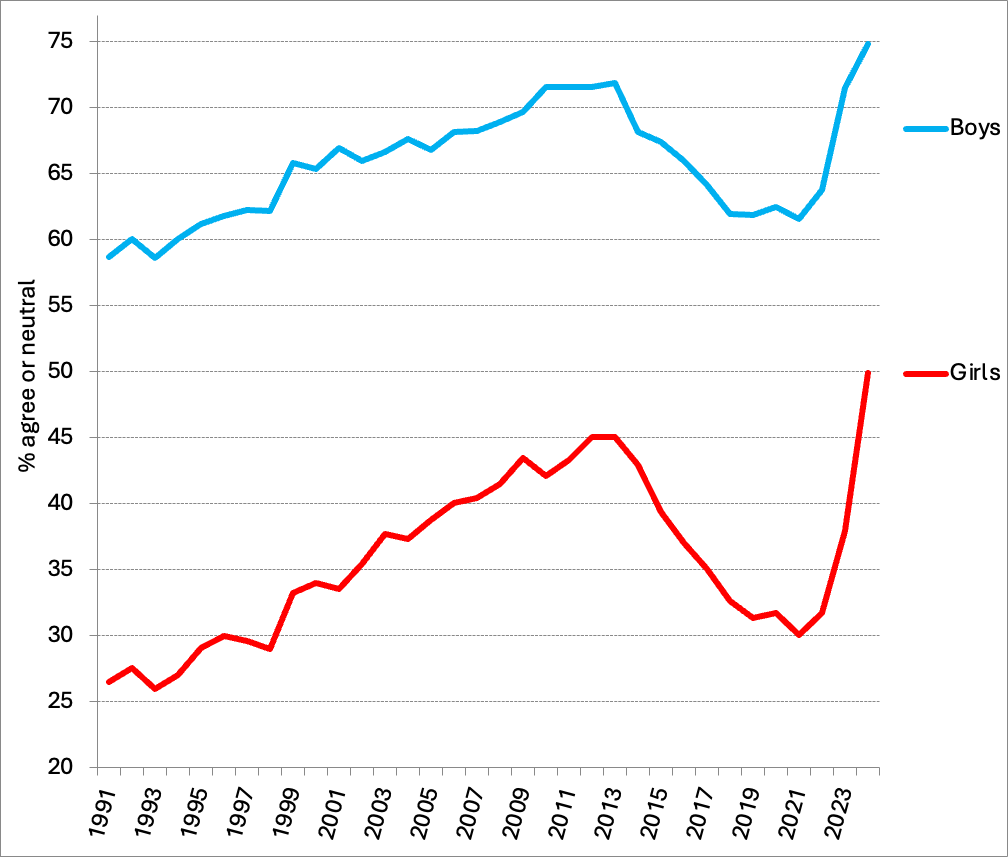
Figure 4: Percent of U.S. 8th and 10th graders who do not disagree it’s best if the man achieves outside the home and the woman takes care of the family, by gender, 1991-2024. Figure shows those who answered agree, mostly agree, or neither. Source: Data from Monitoring the Future analyzed by Jean M. Twenge for the Generation Tech Substack.
Why the sudden shift? Online discourse on social media is once again a possibility – “tradwife” accounts promoting exactly this type of gender role division suddenly started to gain traction a few years ago. It’s hard to say if tradwife accounts are a symptom or a cause, though. Perhaps attitudes shifted toward more traditional gender roles, which is why tradwife discourse caught on. Or tradwife discourse caught on and then attitudes shifted toward more traditional gender roles. Manosphere content may also have promoted these ideas. That content has been around for longer, making it more likely it’s a cause instead of a symptom.
This increasing support for women stepping back from work occurred at a time when nearly 60% of four-year college degrees go to women. Women’s incomes have been rising faster than men’s for a very long time, partially because more young men are not working. These traditional attitudes, especially those questioning equal pay and job opportunities, could be a backlash reaction to how well young women are doing relative to young men.
At the same time, the cost of buying a first home is very high, usually requiring two earners, not to mention the spiraling cost of groceries, gas, and education. With those realities as a backdrop, tradwife culture is unattainable for many.
But Gen Z and Gen Alpha are tired of the rat race. They’re not willing to put in the hours previous generations did at work, partially because they are pessimistic and don’t expect hard work to get them anywhere. That might be why girls have increased even more in their support of traditional gender roles: being a tradwife means they could opt out of the workplace.
No matter what the cause, these are big changes in a short period of time. Teens’ increasing support for rigid gender roles is both surprising given the ascendence of young women in the workplace and not surprising given the cultural shift toward the traditional and online discourse in the last few years. Whether Gen Z and Gen Alpha will live differently due to this shift in attitudes is unclear – we won’t have a good picture of that until they get older. For now, there’s a growing segment of teens who are apparently done with gender equality, with consequences unknown.
I don’t know exactly what questions you asked, but I wonder if you asked the following instead: Do you think most women should concentrate on child bearing and rearing and make being a slave to a corporation, doing crappy, boring, humiliating work for little pay (most jobs - most people are not professors) a secondary goal, i.e., AFTER bearing and raising children to a reasonable age?
Some interesting social science on women’s happiness over the decades and today:
From Brad Wilcox:
“The problem facing liberals, then, is that too many of them have embraced the false narrative that the path to happiness runs counter to marriage and family life, not towards it. They think independence, freedom and work will make them happy, which is why significant portions of the popular media are filled these days with stories celebrating divorce and singleness. […] The secret to happiness, for most men and women, involves marriage and a life based around the family.”
From Nancy Pearcey:
the highest rate of happiness among any group of American women is found in those married to regularly churchgoing men (further:”Compared to secular men, devout Christian family men who attend church regularly are more loving husbands and more engaged fathers. They have the lowest rate of divorce. And astonishingly, they have the lowest rate of domestic violence of any major group in America”
Meanwhile, liberal women are significantly less happy with life than their conservative counterparts. Indeed, according to Pew, the *majority* of young liberal women are mentally ill (!).
All of which to say, maybe people are finally looking around, realizing the harm decades of girlboss lies have caused, and understanding that Proverbs 31 is right after all!
“ Charm is deceptive, and beauty is fleeting;
but a woman who fears the Lord is to be praised.
Honor her for all that her hands have done,
and let her works bring her praise at the city gate.”
Citations here:
https://gaty.substack.com/p/miss-havisham-modern-hero