

Last year, Australia became the first country in the world to pass a law raising the minimum age for social media accounts to 16 and requiring that social media companies verify age. The law went into effect yesterday, December 10.
The official Australian coat of arms depicts a kangaroo and an emu, two native animals that cannot walk backward. They’re also two animals you wouldn’t want to meet in a dark alley if they were snappish.
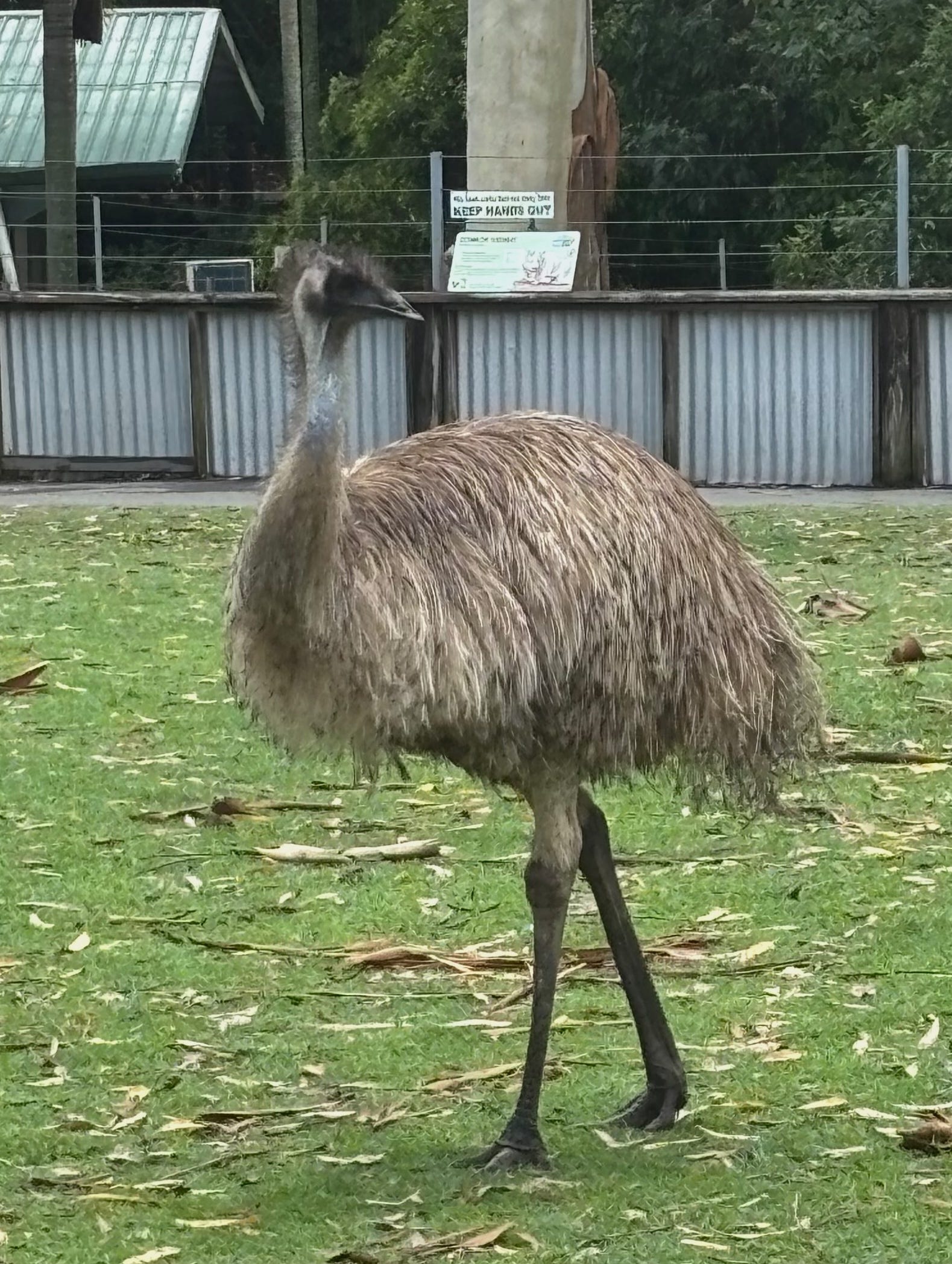
Yes, the photo is pixilated … because I was not going to get too close to the emu. One does not mess with the emu. (Photo taken at Lone Pine Koala Sanctuary outside of Brisbane, Queensland, Australia).
Australia is going to need the spirit of the kangaroo and the emu as the law goes into effect – they should not move backward and should fight if necessary. Australia had the courage to be first, and that’s going to mean there will be challenges along the way. But they should persevere, because the arguments against the law are weak and sometimes even nonsensical.
Why have a law keeping under-16s from creating social media accounts in the first place? It is abundantly clear that social media is not safe for kids. Social media companies know that children and younger teens spend more time on the apps because their self-control is not as developed (An internal document from TikTok admitted, “TikTok is particularly popular with younger users who are particularly sensitive to reinforcement in the form of social reward and have minimal ability to self-regulate effectively.”) Kids are tempted to open social media again and again through endless notifications, including in the middle of the night. Links between social media use and poor mental health are larger among those under 16 compared to those over 16. Unknown adults can easily contact kids on these platforms, and inappropriate content is rampant even on so-called teen accounts. These are among the reasons why “No Social Media Until Age 16 – Or Later” is Rule #3 in 10 Rules for Raising Kids in a High-Tech World.
In most countries, age isn’t verified when kids sign up for a social media account, so 11-year-olds easily sign up for Snapchat and Instagram even though the law says they need to be 16. But 13 is a terrible age to introduce social media, and teens want to do what their friends are doing.
With a law setting 16 as the minimum age and verifying it, Australian parents will be a lot less likely to hear their kids say, “But Mum, all of my friends use Instagram! If I’m not on it, I’ll be left out!” Kids will have to say, in effect, “But Mum, all of my friends are breaking the law!” – a little less persuasive. As an American parent, I can only wish I lived in a country that would support me in keeping my kids off social media until they were 16. If Australia’s ban goes well, other countries (and perhaps some U.S. states) might follow, so the stakes are high.

My kids & other visitors with the friendly kangaroos at Lone Pine. Still not going to challenge one to a fight, though.
Of course, not everyone is sold on the idea. Here are the most common arguments against Australia’s law – and why I think they don’t hold water.
• Kids and teens will find work-arounds to get on the platforms anyway. It’s completely true it may take some time to make age verification completely effective. But that’s not a reason to give up. Imagine if someone used this argument against age minimums for buying alcohol: “Teens are just going to find a way around it, so the law is stupid.” Yes, some teens get fake IDs so they can buy alcohol. But most don’t. Almost immediately after the drinking age was raised to 21 in the U.S. in the late 1980s, fewer teens drank alcohol. The downward trend then continued as drinking became steadily less popular among 13- to 18-year-olds. The decline in teen alcohol use is also one of the reasons teen deaths in car accidents went down in a similar pattern. The government got better at enforcing the law, and then social norms took over and made it less acceptable to drink while underage. The same will be true for social media: Enforcement will improve, and eventually the social norm will move away from teens feeling they “have” to be on social media.
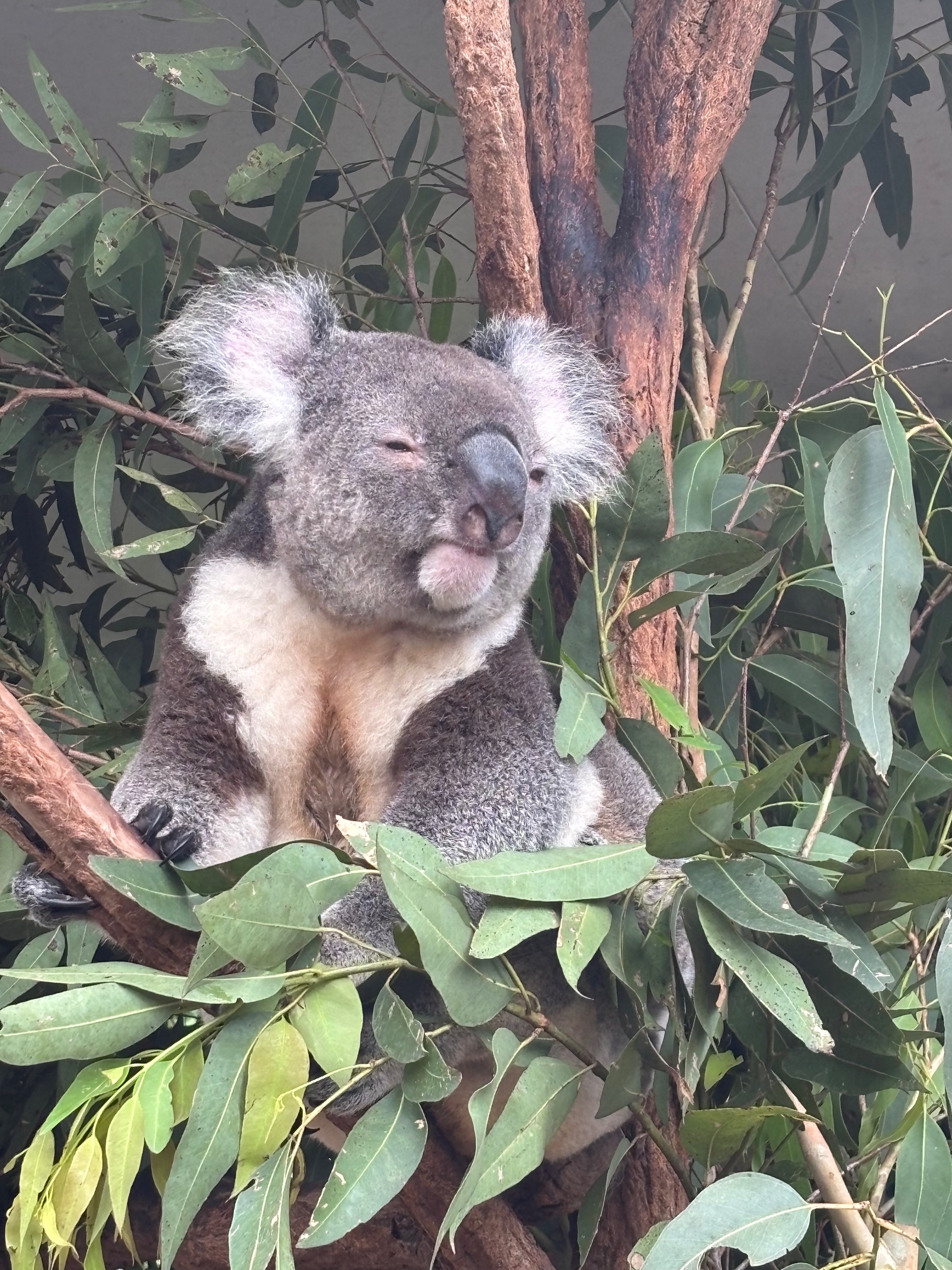
See those claws? You don’t want to make them mad either. And that squint says, “Don’t even try using a VPN in my house, honey.” (Also taken at the Lone Pine Koala Sanctuary. It’s awesome.)
• Teens in vulnerable groups will be cut off. For example, a CNN article noted, “Experts who work closely with vulnerable and isolated children warn that taking away social media platforms from those children could deprive them of support networks, making them feel even more isolated and alone.” This argument makes two false assumptions. First, it seems to assume that social media is the only way for vulnerable teens to have a support network. That’s just not true. If teens want to seek out information, they have the rest of the internet. If they want to communicate with others like them, they can call, FaceTime, text, or use WhatsApp. They can also use Discord or Pinterest, which are still allowed for under-16s in Australia. Second, this viewpoint takes for granted that social media use necessarily benefits children in vulnerable groups. Where is the evidence that vulnerable teens who spend more time on social media are happier on average than those who don’t use social media or who use it only lightly? I don’t know of any. If anything it’s the opposite. And if the era of social media was so good for teens in vulnerable groups, why have their rates of depression increased just as much or more than those in less vulnerable groups? Plus, vulnerable teens get bullied more on social media. The risks outweigh the benefits.
• Let’s teach digital literacy to kids instead. Good luck. As one Australian dad put it, “I’m an adult and I know what an algorithm is, but it still gets me.” Yes, we should talk to kids about how to stay safe online. But expecting them to self-regulate their social media use is unfair and unrealistic when the social media companies have poured billions into making their apps as addictive as possible. We should do both: Keep kids off social media until they’re older, and teach them digital literacy.
Stay strong, Australia. The rest of us are counting on you.
Personal p.s.: I fell in love with Australia the first time I visited in 2004. I’ve now traveled there 9 times and love it more every time I go. I took the pictures above just a few hours after getting off the plane on my last visit; I am convinced that the best thing to do after stumbling off a 14-hour overnight flight is to pet kangaroos and take pictures of koalas. I’ve wished I lived in Australia many times over the past 21 years, and now with the new social media law I really do.
While I largely agree the law is a good idea and should be replicated here in the U.S., leaving Discord and Pinterest alone seems like an inevitable future problem as they likely shift their strategies to being more social-media like to gain market share among teens wanting a replacement (let alone other companies shifting their strategies). This means the law would need to be updated, as laws sometimes do, but it points to why this, as with laws in general, only generally work well when the populace is buying into the argument. More than kids, adults need to be provided greater media savvy skills, and, more helpful, a fundamental shift towards anti-fragility practices needs to be implemented in families, schools, and society at large.
I do find it rather interesting how you chose to use America's 21 drinking age as a comparison. The best studies on the matter (Miron and Tetelbaum 2009, Asch and Levy 1987 and 1990, Dee and Evans 2001, Males 1986 and 2007, and Dirscherl 2011, among others) have found that the supposed net lifesaving effect of those illiberal laws was essentially a mirage in the long run, and/or that it had at most a minor impact on teen drinking in the long run as well. Also note that several other countries, such as Canada, have also seen similar drops in teen drinking and drunk driving deaths despite NOT raising the drinking age to 21.
It seems that all the 21 drinking age really does is force drinking underground and make it far more dangerous than it has to be. We ignore this timeless lesson at our own peril.
To paraphrase a wise man, the first three years of legal adulthood and citizenship should NOT be a lesson in hypocrisy and lawbreaking.
Let America be America again, and lower the drinking age to 18. If you're old enough to go to war, you're old enough to go to the bar. 'Nuff said.