

Last week, I found that more U.S. teens suddenly began to support more rigid gender roles in recent years, even becoming more likely to not agree with men and women getting equal pay for equal work. I concluded that “the manosphere and tradwife culture have won.”

Not completely, of course, but it’s clear they’ve had some impact when the number of teen boys who don’t agree with equal pay for women goes from 12% to 22% (since 2017, with most of that change occurring 2022-2024). In my view, it’s not a coincidence that these attitudes shifted in the age of ubiquitous social media use and the concomitant rise of manosphere and tradwife influencers.
In discussion of the post on X, this comment popped up:
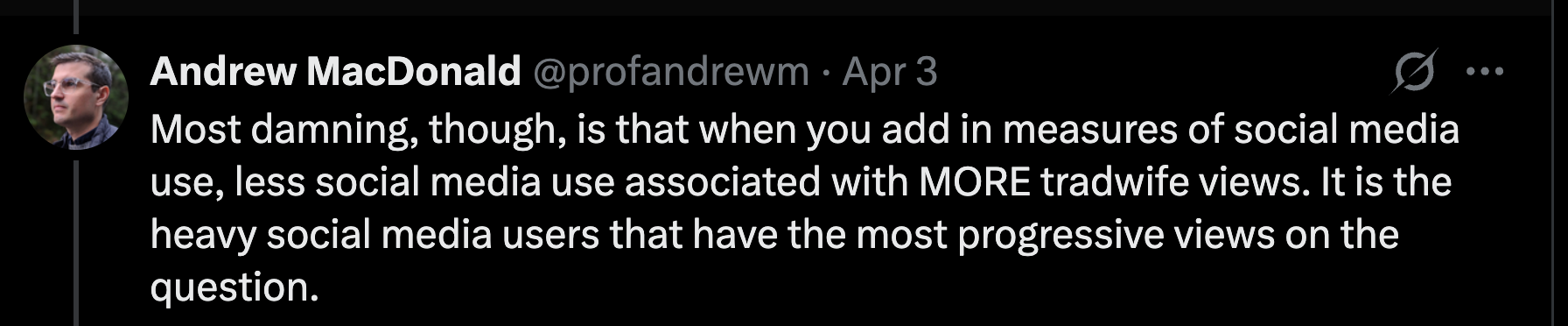
My initial thought was “OK, fine, it’s probably not just time spent – teens could still be influenced by manosphere and tradwife content in an hour or so a day.” An inverse relationship also seemed at least somewhat plausible as I’ve found (with 12th graders) that more liberal students spend more time on social media. Still, I thought, that might not be true for these particular views around gender … and then I realized: Why speculate when I can go look at the data? And the link between social media use and gender beliefs is an interesting research question.
I used 8th and 10th graders in Monitoring the Future 2018-2024, as the response choices changed for the social media questions in 2018. I looked at hours per day of social media use and the percentage who agreed or mostly agreed that “It is usually better for everyone involved if the man is the achiever outside the home and the woman takes care of the family.” The results are separated for boys vs. girls and controlled for grade level (8th vs. 10th), race/ethnicity, and socioeconomic status (mother’s education). Total n was 24,971, so a nice sample size.
So, do heavy social media users have the most progressive views, as Dr. MacDonald posted on X?
They do not – in fact, it’s the opposite. Especially among boys, more social media use means more agreement with rigid gender roles (see Figure 1). And it’s not subtle: Among boys, 43% of the heaviest social media users agree with rigid gender roles, compared to 27% of non-users. That translates to 56% more heavy users (vs. non-users) with traditional views among teen boys.
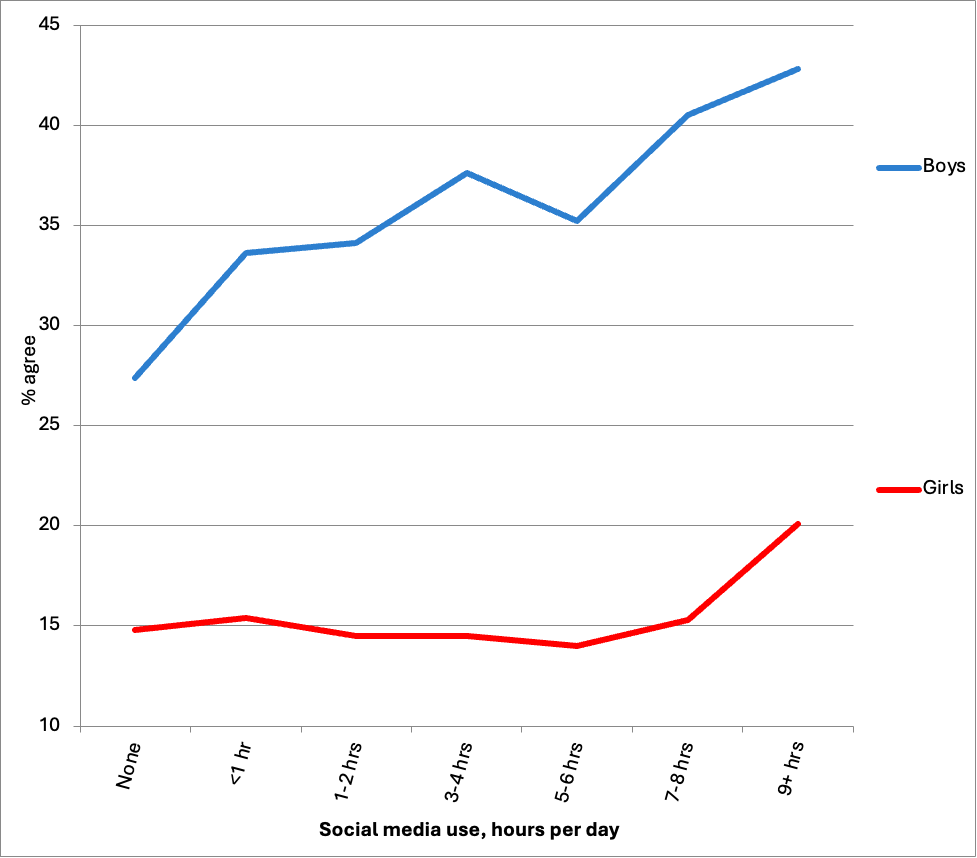
Figure 1: Percentage of U.S. 8th and 10th graders who agree it’s best if the man achieves outside the home and the woman takes care of the family, by hours per day of social media use and gender. Figure shows those who answered agree or mostly agree; data are from 2018-2024 combined. Controlled for race/ethnicity, grade, and socioeconomic status (mother’s education). Source: Data from Monitoring the Future analyzed by Jean M. Twenge for the Generation Tech Substack.
The association is not as strong among girls, but even there the heaviest social media users are 36% more likely to hold traditional views than non-users.
Thus: heavy social media users have the least progressive views, not the most progressive views as Dr. MacDonald claimed.
I’m not sure why he got this wrong. Maybe he thought the item was scored in the other direction? He did say he was looking at only the 2023 and 2024 data, but the pattern looks the same even with only those two years. Or perhaps he didn’t separate the data by sex or control for it. That’s essential, as girls spend more time on social media and are less likely to agree with this question.
So, assuming the graph above is instead correct, what does this mean? More social media use is linked to belief in more rigid and traditional gender roles, supporting the theory that time spent on social media is associated with more traditional views of men and women’s roles. It seems likely that a combination of more hours on social media plus more manosphere and tradwife content is at least partially behind the rise in support for more rigid gender roles.
The more linear and larger association among boys deserves exploring. Perhaps hours per day has a stronger influence on boys’ exposure to the manosphere and tradwife culture than it does for girls, who might be consuming other types of content more often. This is the opposite of what we usually see with social media and mental health, where effects for girls are larger than for boys. Perhaps hours per day on social media has a bigger impact on girls’ mental health and on boys’ beliefs, especially gender role beliefs.
Another conclusion: Don’t believe everything you read on X.
Echoing one of the comments below, I wonder at your choice of word "rigid." Does traditional = rigid? I'm a therapist working with gender confused adolescents and I'm all in favor of less "rigid" gender models, but I can't help feeling that the word carries a value judgment here. Is it rigid to believe that women are better equipped than men to handle the emotional responsibilities of child-rearing?
Very interesting. Would love to see a deeper dive on this and curious about differences in groups with lower SES some day. Thank you for sharing!