

In a previous post, I found that identifying as gay, lesbian, or bisexual plummeted among U.S. young adults after 2022, with most of the decline driven by fewer women identifying as bisexual.
But are younger adults just less likely to identify as non-heterosexual, or are they also less likely to engage in non-heterosexual sexual activity? In other words, are there trends in behavior, or just identity?
One of the few national surveys that has measured sexual activity over time is the General Social Survey (GSS) — it’s asked American adults about the sex of their sex partners since 1988. Unfortunately the survey didn’t ask all of the questions about sexual activity in 2024, but it did ask people whether they had sex with men, women, or both in the last year.

Since the sample sizes of the GSS are smaller than some other national surveys, I broadened the age range for younger adults to 18 to 39 to make sure there were at least ~500 respondents for each year, and thus at least ~250 or more for each sex.
As always, take these results with the caveat that future years will give us a clearer picture of what’s going on.
So what are the trends in non-heterosexual sex among younger adults in the U.S.?
In short: Fewer women are having sex with women in 2024 than just two years before.
Just like the changes in identity, the recent trends in sexual behavior are the most dramatic for women. Non-heterosexual sex (having sex with another woman in the last year) dropped by more than half between 2022 and 2024 among 18- to 39-year-old women in the U.S. Previously, the number of women having sex with women had doubled between 2010 and 2022 (see the red line in Figure 1). So there was a big increase, and then a big decrease.
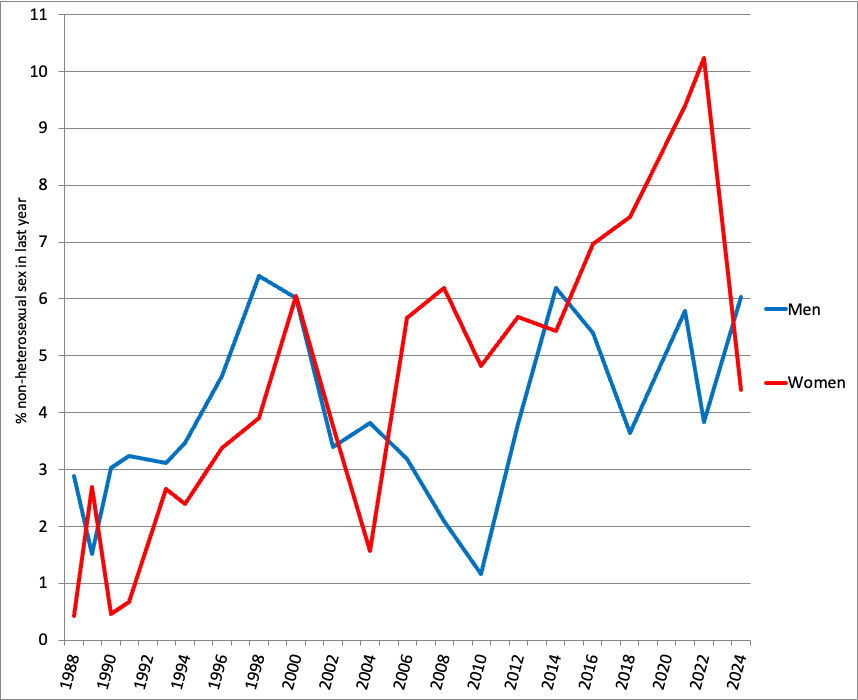
Figure 1: Percent of U.S. 18- to 39-year-olds who had sex with someone of the same sex in the last year, 1988-2024. Source: General Social Survey; data analyzed by Jean M. Twenge for the Generation Tech Substack.
The recent pattern is less clear for men, with ups and downs but little consistent trend. More men had sex with men between 1988 and 2000, but then those rates declined before coming up again in 2014 and varying between 4% and 6%. The rates never got above 7% as they did for women in 2018 (7.4%), 2021 (9.4%), and 2022 (10.2%).
By 2024, fewer women were having sex with women than men having sex with men, which had not happened since twenty years before in 2004.
Especially with the lower sample sizes, it will be important to get at least another year of data to determine whether this is a blip or part of a new trend. The 2026 GSS is being fielded right now, so we’ll know more next year. For now, it appears the decline in women identifying as bisexual extends to who they’re having sex with as well.