

Last fall, researcher Eric Kaufmann concluded that “trans identification is in free fall among the young.” His declaration was a little premature – his sources measured identifying as non-binary, not transgender, and were not nationally representative. But after digging into the best data I could find, I concluded he was probably right: Identifying as transgender and non-binary really did decline among U.S. young adults after 2023, and even among teens as young as 13.
Kaufmann found that identifying as lesbian, gay, or bisexual was also declining, but most of his sources were college samples. At the time there wasn’t much nationally representative data on sexual orientation for 2024 or 2025, and the little there was had low sample size.

That nationally representative data is now available. So is it true – is identifying as non-heterosexual in decline among American young adults?
The answer appears to be yes, and the changes are even larger among some groups. I drew from the nationally representative Behavioral Risk Factor Surveillance System of U.S. adults administered by the CDC, which gets samples of more than 200,000 people every year. The 2024 data is fully out, and that datafile also has some responses from 2025 (12,000 – much smaller than a full year, but a large sample size compared to many other surveys). The survey asks about sexual orientation with choices of straight, bisexual, gay or lesbian, and “other” or “something else.” (Because those last choices changed over the years, I treated them as missing data).
Among American young adults (ages 18 to 24), identifying as lesbian, gay, or bisexual – something other than straight or heterosexual – peaked in 2022 at 20%, but then fell to just over 15% by 2025. That’s a 21% decline in just 3 years.
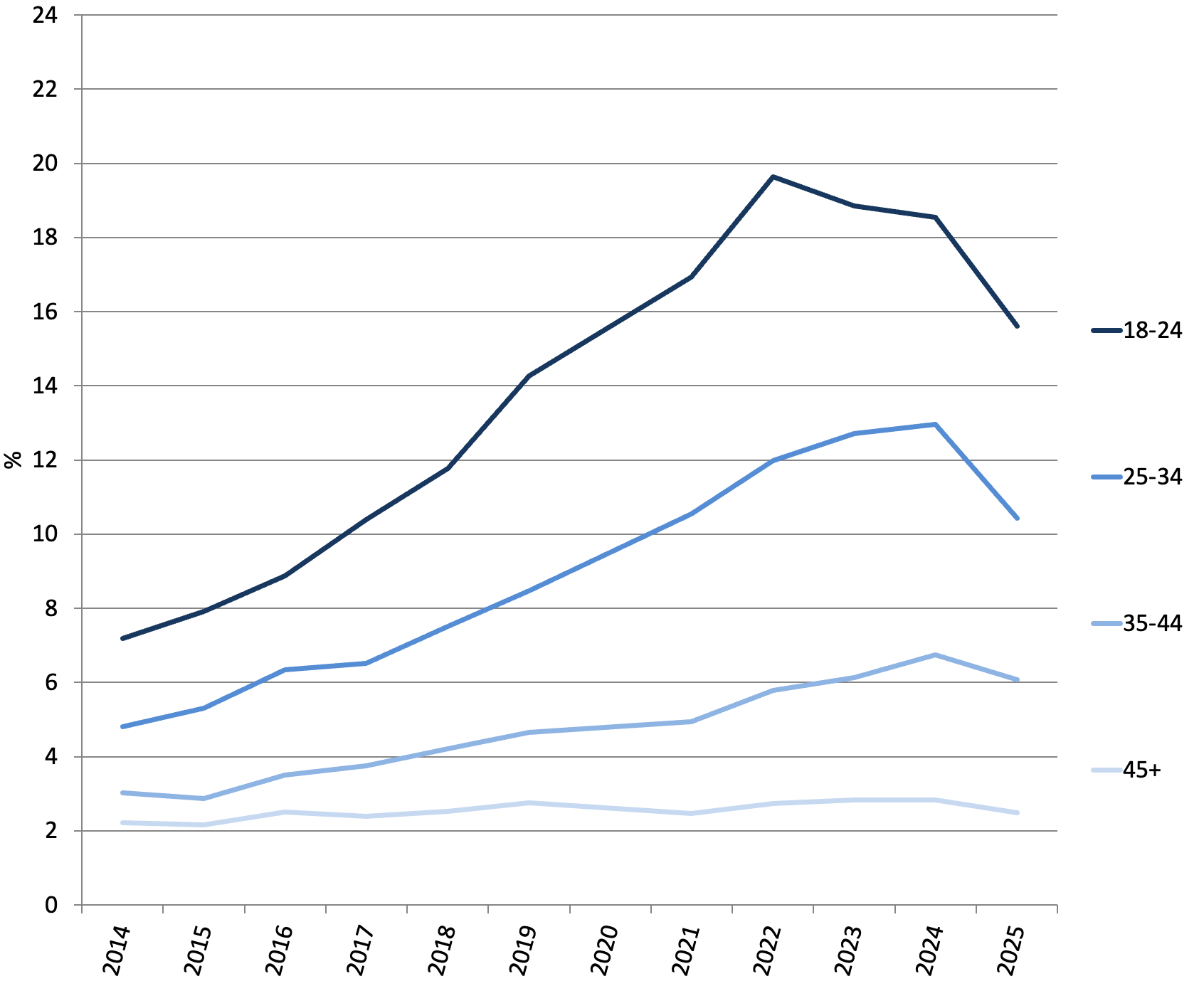
Figure 1: Identifying as lesbian, gay, or bisexual (not straight), by age group, U.S. adults, 2014-2025. Source: Behavioral Risk Factor Surveillance Survey. NOTE: 2020 data are excluded as data collection was paused for much of the year due to the COVID pandemic. Survey year is interview year in the dataset, not the year of the datafile.
Among 25 to 34-year-olds, identifying as non-heterosexual kept rising until 2024, dropping 20% in 2025. There’s just a slight hint of a decline among 35- to 44-year-olds, and only a whisper of it among those over 45 years old. With only one year of decline among those in their late 20s to early 40s, we’ll need more data to know for sure if the decline will persist. But for now, this is a classic generational shift, with the changes first and largest among the youngest group.
So which identification (lesbian, gay, or bisexual) has changed the most among young adults? It’s definitely identifying as bisexual, especially among young women. This shift drives almost all of the change seen in Figure 1. As recently as 2015, only 8% of U.S. young women identified as bisexual, but by 2022 23% did — the rate nearly tripled in just 7 years. But by 2025, the percentage of young women identifying as bisexual had dropped to less than 18% (see Figure 2). That’s a 23% decline in 3 years. There was also a decline in young men identifying as bisexual, but not until 2025.
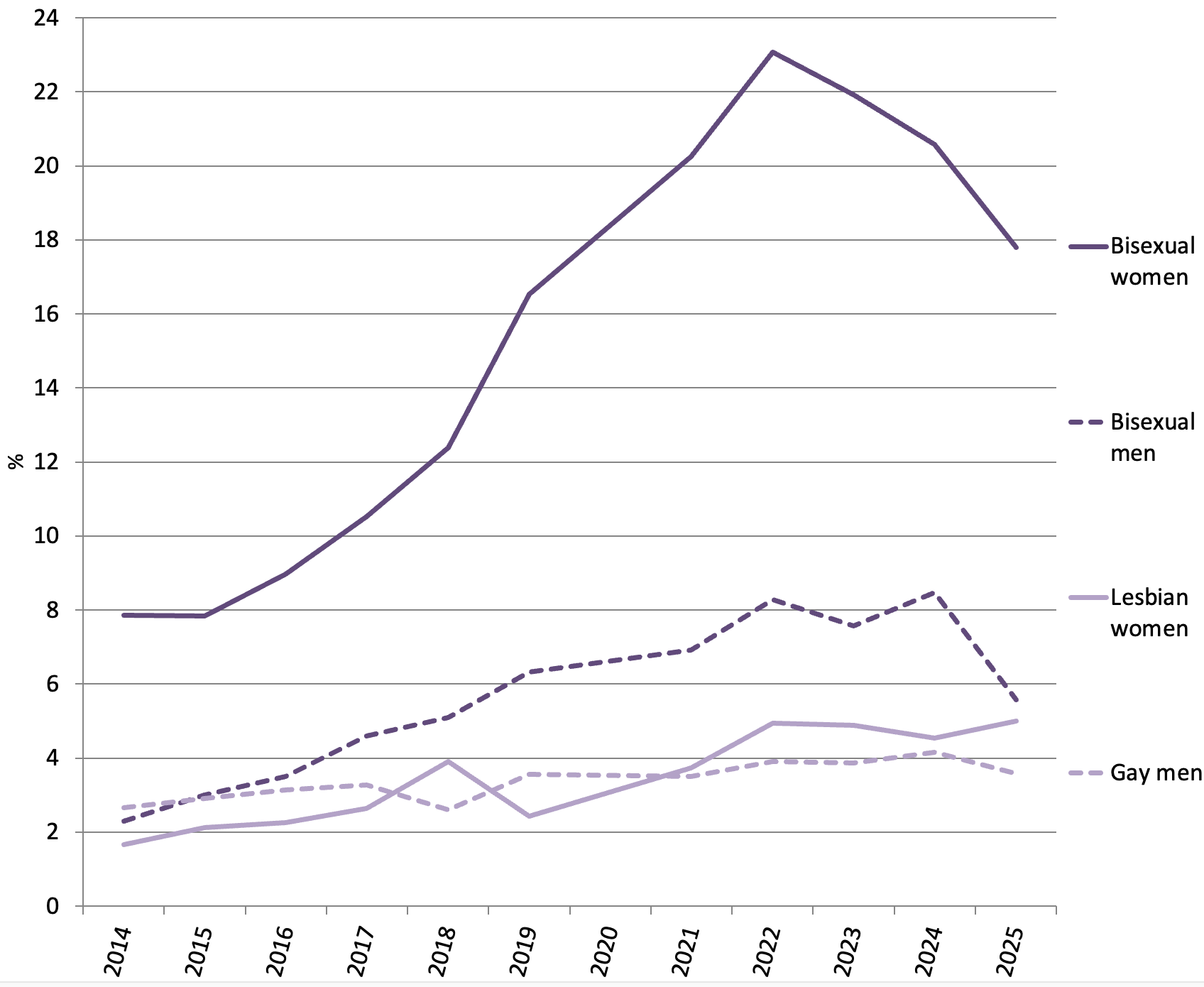
Figure 2: Identifying as lesbian, gay, or bisexual, by gender, U.S. adults ages 18 to 24, 2014-2025. Source: Behavioral Risk Factor Surveillance Survey. NOTE: 2020 data are excluded as data collection was paused for much of the year due to the COVID pandemic. Survey year is interview year in the dataset, not the year of the datafile.
Similar to non-heterosexual identification overall, the percentage of women identifying as bisexual changed the most among the youngest adults, but less and later among those who were older (see Figure 3).
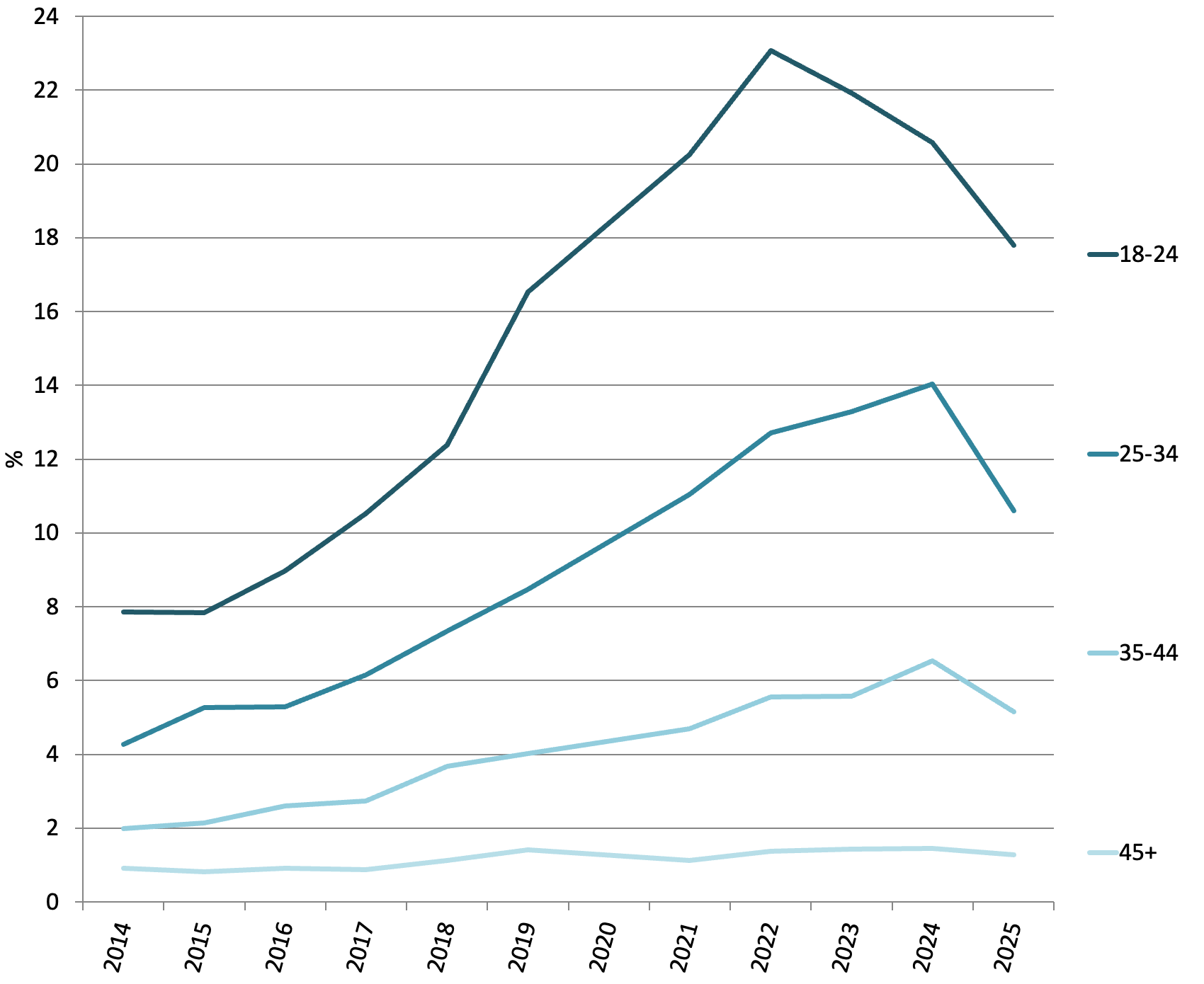
Figure 3: U.S. women identifying as bisexual, by age group, 2014-2025. Source: Behavioral Risk Factor Surveillance Survey. NOTE: 2020 data are excluded as data collection was paused for much of the year due to the COVID pandemic. Survey year is interview year in the dataset, not the year of the datafile.
Combined with the data on declining transgender and non-binary identification, this means fewer U.S. adults identified as members of the LGBTQ+ collation in 2024-25 vs. 2021-22. Fewer identify outside the gender binary, and fewer identify as a sexual minority. The cyclical nature of these changes, especially their appearance among the youngest adults, suggests a cultural shift – one that might grow or fade during the coming years.
The 2025 interviews were in only states that couldn't finish the survey before the end of 2024, so data collection extended into early 2025. I am not sure then that the 2025 numbers can be directly compared with the full-year datasets. I'd also point out that the weighted frequencies reported in the Codebook do not seem to back the last paragraph's assertion that fewer Americans in general identified as LGB in 2024 compared to 2022.
I guess there was nothing specifically analyzing "trans" among these groups, except for maybe "other". I would expect those trends to be similar but it would be nice to see that specific data at some point.