

PISA, the international program that measures 15- and 16-year-olds’ academic performance, released its 2025 data last week.
The results are, in a word, terrible.
The PISA tests of math, reading, and science are normally administered every three years, with the 2021 assessment was pushed to 2022. Between 2018 and 2022, no one was particularly surprised that test scores went down. Students were barely out of pandemic lockdowns; in many countries online school went on for more than a year, with learning losses as a result.
The 2025 data gives us our first true look at academic performance in the post-pandemic era when students had been back at in-person school for several years. Given that, one might expect that test scores would rebound, perhaps to 2018 levels.

Not only did that not happen, but scores were even lower in 2025 than in 2022, especially in the core subjects of math and reading (see Figure 1 for the trend worldwide; this is based on my analysis of the publicly available raw data). And, as I’ve reported previously, the decline in test scores began well before the COVID-19 pandemic, starting around 2012 (that familiar year when teen mental health also began to suffer).
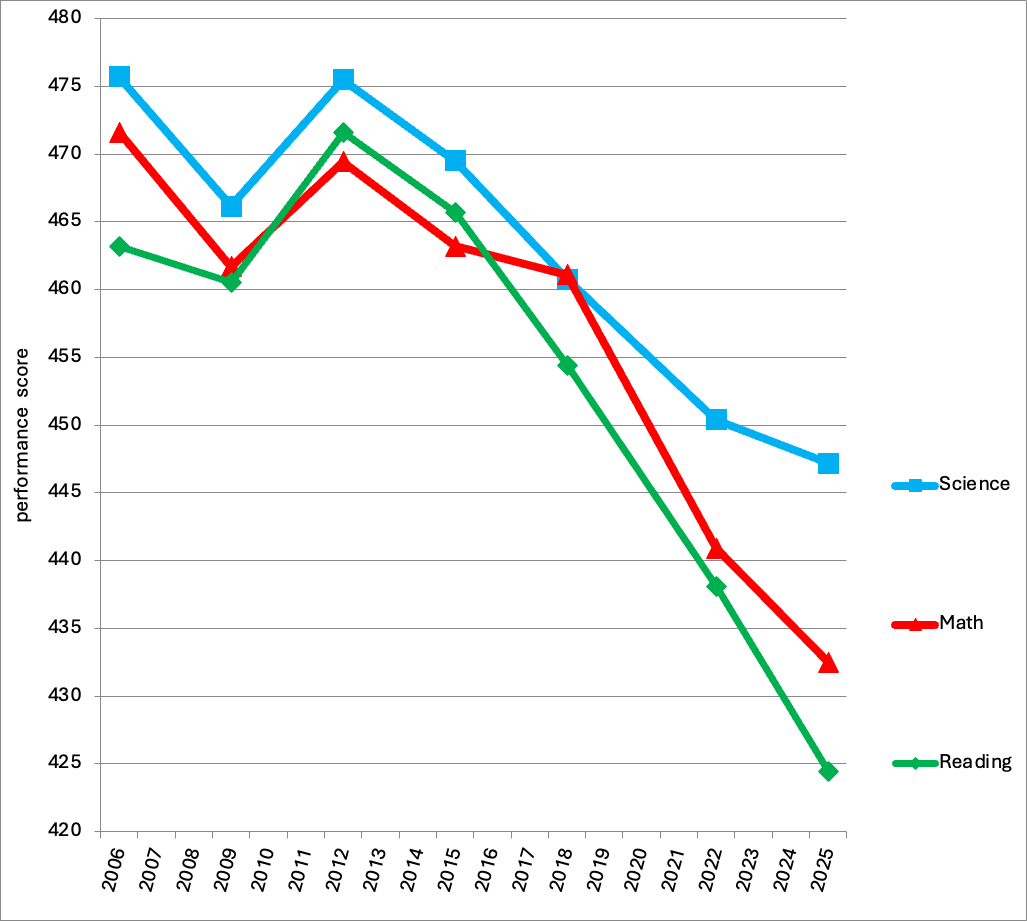
Figure 1: Academic performance in science, math, and reading, all countries, 2006-2025. Source: PISA. Note: Data are unweighted and thus scores may differ from graphs using data weighted by the sample weight or by population. Includes all countries with data, not just OCED countries as in other reports.
On the PISA performance score, 25 points equals about one year of schooling. Between 2012 and 2025, reading scores declined 47 points. That means 2025 students are nearly 2 grade levels below 2012 students in reading. Thirty points of that decline happened since 2018.
Math scores declined 37 points since 2012, so about a grade level and a half. Science scores are down 28 points, about a grade level. Adolescents around the world are much less capable in major academic subjects than they were just 13 years ago.
Given the importance of the topic, it pays to take a deeper and more precise look at this data. Different countries have participated in PISA over the years, so it’s a good idea to do an analysis including only countries that have data for all or most years. Since the declines start in 2012, it’s also important to have data for that year. If different years also have different samples of countries included, that creates the possibility that the trends are due to a shifting sample. Restricting the analysis to countries with data in the relevant years takes care of that.
Also, regions of the world differ in economic, cultural, educational, and technological trends, so it’s also informative to examine trends within regions. Using these requirements and grouping countries into five regions (Western Europe, Eastern/Central Europe, English-speaking, Latin America, and Asia) results in a sample of 36 countries. I haven’t seen anyone else do this type of analysis yet with the PISA data up to 2025, so I crunched the numbers in the data files.
The end result: There are still large declines in test scores, especially in Western Europe, English-speaking countries, and Asia.
Both math and reading scores are down more than a grade level among students in Western Europe. Science scores are down about half a grade level (see Figure 2).
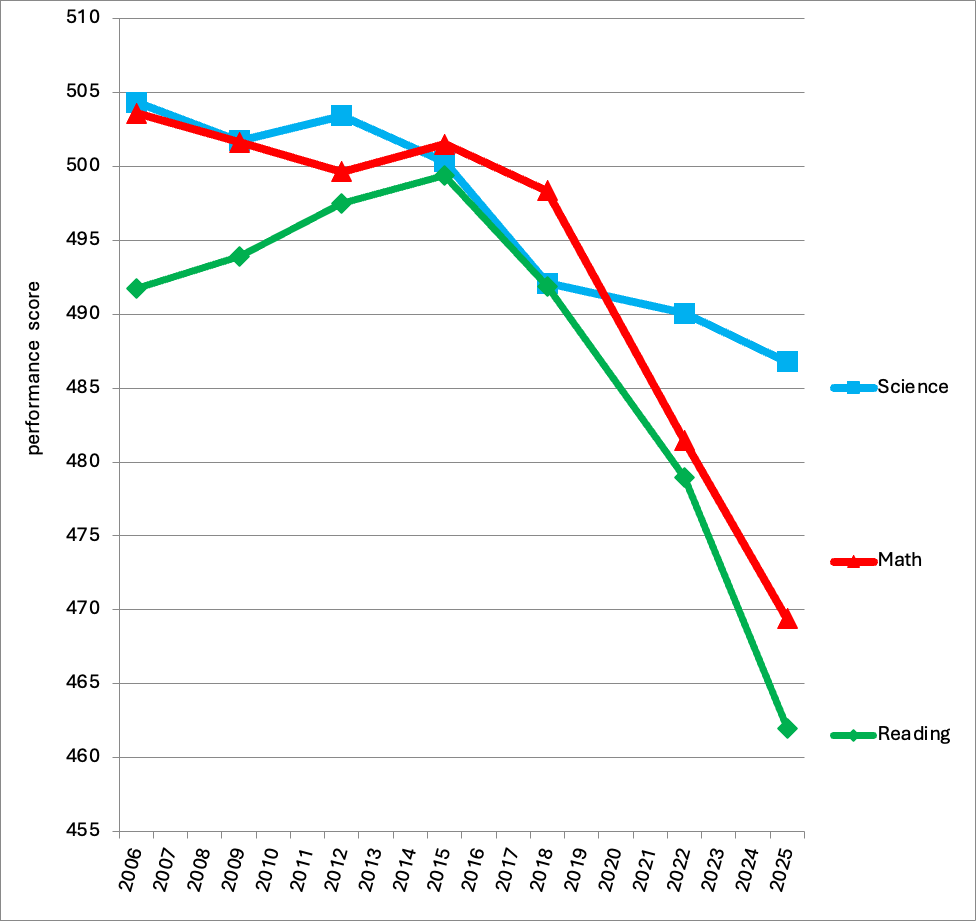
Figure 2: Academic performance in science, math, and reading, Western Europe, 2006-2025. Source: PISA. Note: Data are unweighted and thus scores may differ from graphs using data weighted by the sample weight or by population.
In English-speaking countries (Australia, Canada, Ireland, New Zealand, the UK, and the U.S.), math scores were declining even before 2012 and are now a full grade level lower than they were in 2006. Reading scores held their own for awhile but then fell off a cliff, declining nearly a grade level between 2018 and 2025. Science scores are down about half a grade level since 2006 (see Figure 3).
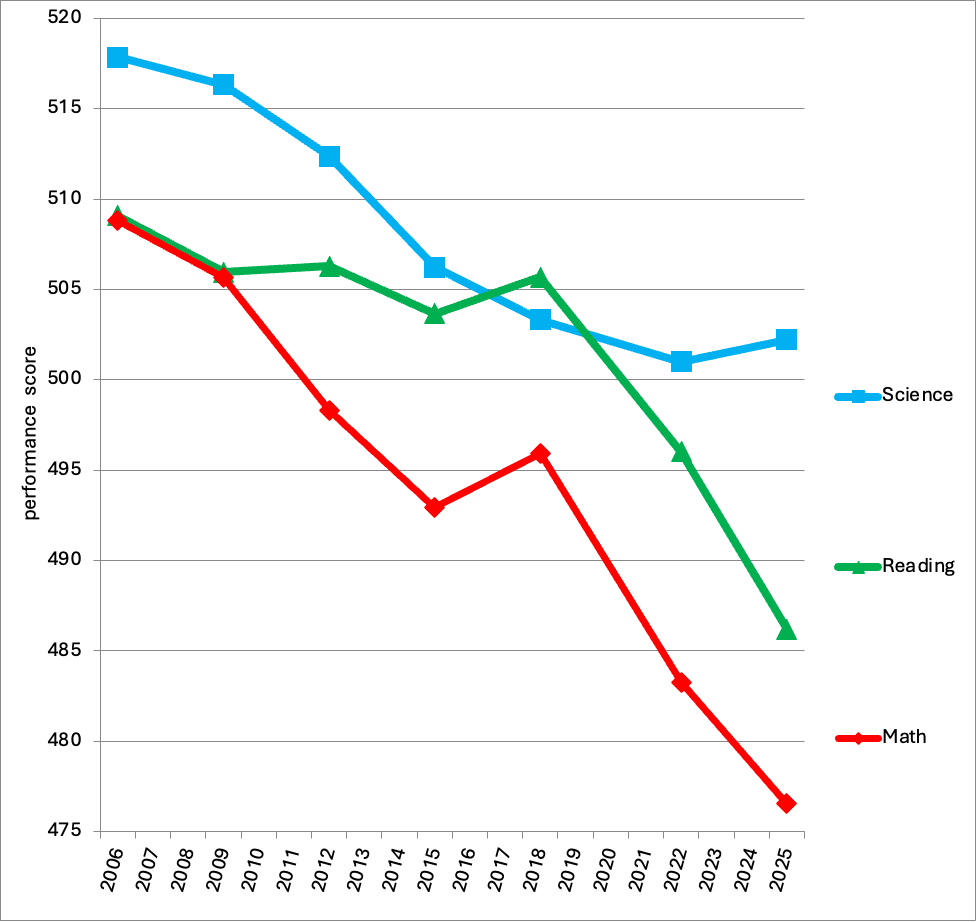
Figure 3: Academic performance in science, math, and reading, English-speaking countries, 2006-2025. Source: PISA. Note: Data are unweighted and thus scores may differ from graphs using data weighted by the sample weight or by population.
In Asia, test scores peaked in 2012. Reading scores declined 53 points, two entire grade levels, between 2012 and 2025. Math scores declined 35 points, more than a grade level, and science scores declined about a grade level (see Figure 4).
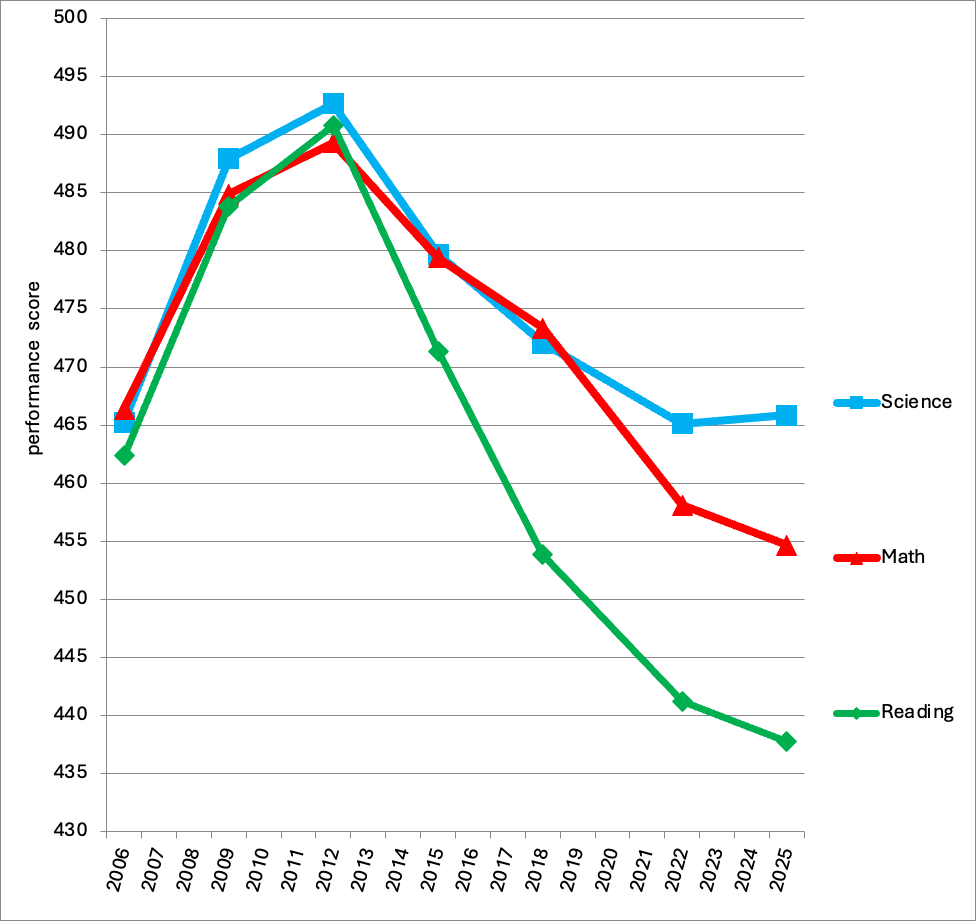
Figure 4: Academic performance in science, math, and reading, Asia, 2006-2025. Source: PISA. Note: Data are unweighted and thus scores may differ from graphs using data weighted by the sample weight or by population.
So why did test scores continue to decline between 2022 and 2025, including in some of the most prosperous nations in the world?
Here are some explanations worth considering:
1. Pandemic learning loss. If the declines were due to the pandemic, one would have expected that academic performance would be better in 2025 than it was in 2022 – students had three or more years of in-person school. But perhaps pandemic learning loss from earlier grades compounded and students weren’t able to catch up. The 15- and 16-year-old students taking these tests in 2025 were 10 and 11 years old when the pandemic hit in 2020. In the U.S. school system, that’s 5th grade. Most would have spent part of their 6th grade year in online school as well. If they missed out on fundamental reading and math skills during this time, their post-pandemic years in 7th, 8th, 9th, and 10th grade might not have been enough.
2. Use of AI. ChatGPT was introduced on November 30, 2022, and within a few months students were using it and other generative AI systems to write their essays and do their math problem sets. Several studies have shown that students who use AI whip through their homework but then bomb tests because they don’t actually learn the material. That would show up on standardized tests like these where students can’t rely on AI.
3. Laptops and phones. Students spend between an hour and two hours using personal devices during school, with nearly all of that time spent using social media and watching videos. (Yet another reason to put off giving your kid a smartphone until they are older; give them a basic phone instead — see Rule 4 in 10 Rules). School-issued devices are an issue as well; many school laptops do not restrict streaming services and games, allowing students to entertain themselves during class instead of paying attention. This cohort of students entered middle school during and after the pandemic when providing laptops or tablets for each student had gone from common to nearly universal. School-issued devices are also distracting at home, where students assigned digital homework are tempted to instead watch YouTube or stream movies or TV on Disney+. (Which I found out when my middle schooler did just that. She’s not a hacker, nor did she find a clever workaround; Disney+ was not blocked at all on her school-issued laptop).
4. Attention spans and trouble focusing. Another possibility is the impact of social media and short-form video on teens’ brains. These activities may have shortened their attention spans and made it harder for them to concentrate. Fewer teens also read for pleasure. Thus, it becomes more and more difficult for students to focus on schoolwork, especially material that requires deep concentration.
I think all of these are possible reasons for the decline in academic performance among teens worldwide. I’d love to hear what you think – are there other possible causes? Which of these four seems most plausible to you? And what can we do to reverse these very concerning declines in academic performance?
I'll ask a basic question which you might have answered in another post: given the overwhelming evidence that digital distractions have caused educational outcomes to plummet, why do schools continue to insist on using laptops and iPads, and now AI, in the classroom? It goes against all common sense. If I have trouble focusing with the equivalent of a TV and more on my desk during work, surely it's obvious that children would have even more trouble?
I wonder about the style of teaching over the last couple of decades as well. The philosophy behind “common core” where it concerns math makes sense, it’s about learning why the math works. However, where learning how is appropriate when it pertains to calculus and further, more basic math is about memorization. That’s the groundwork laid for later extrapolation. Add in that such requires cognitive development that comes with age, and the new teaching is requiring younger students to think as if they’re several years ahead of where they actually are developmentally. Then there’s the activism of high school teachers becoming similar to college professors. This goes beyond grade inflation to a diminished requirement for students to analyze or be able to read anything, replacing it with regurgitating talking points. I know several teachers, admittedly those who teach English so critical theory is ascendant, but even in advanced classes barely require any reading, but do love giving presentation assignments about how the stories highlight modern fascism, note the evils of capitalism, and so on. Actual reading isn’t important, only right-think.