

Last year, several researchers – including me – found that fewer U.S. young adults were identifying as lesbian, gay, or bisexual in 2024 and 2025 than just a few years before.

At that point, though, the 2025 data for the nationally representative Behavioral Risk Factor Surveillance Survey (BRFSS), administered by the CDC, was incomplete, covering only January and February. Another survey had only a sample from June 2025, and it had changed its design from earlier data collections.
To get the data for the whole year, we’d have to wait until the next BRFSS datafile was released. That would be more definitive for three reasons: The sample size would be much larger (and thus less prone to random variation), the BRFSS design stayed the same over the years unlike the other survey with the June data, and the year comparisons would be equal (comparing full years to each other instead of full years to just a few months in 2025).
That moment arrived last week when the BRFSS released its 2025 data.
The results were not what I expected.
While the first two months of data from 2025 had shown a decline in identifying as LGB among young adults 18-24, the full year of data did not. It instead showed a slight uptick, with LGB identification in 2025 similar to to 2022 (see Figure 1).
Now that we have all of the data from 2025, it appears non-heterosexual identification is not declining (at least not anymore). However, it has stabilized and is no longer racing upward as it did between 2014 and 2022, when identifying as LGB nearly tripled among U.S. 18- to 24-year-olds.
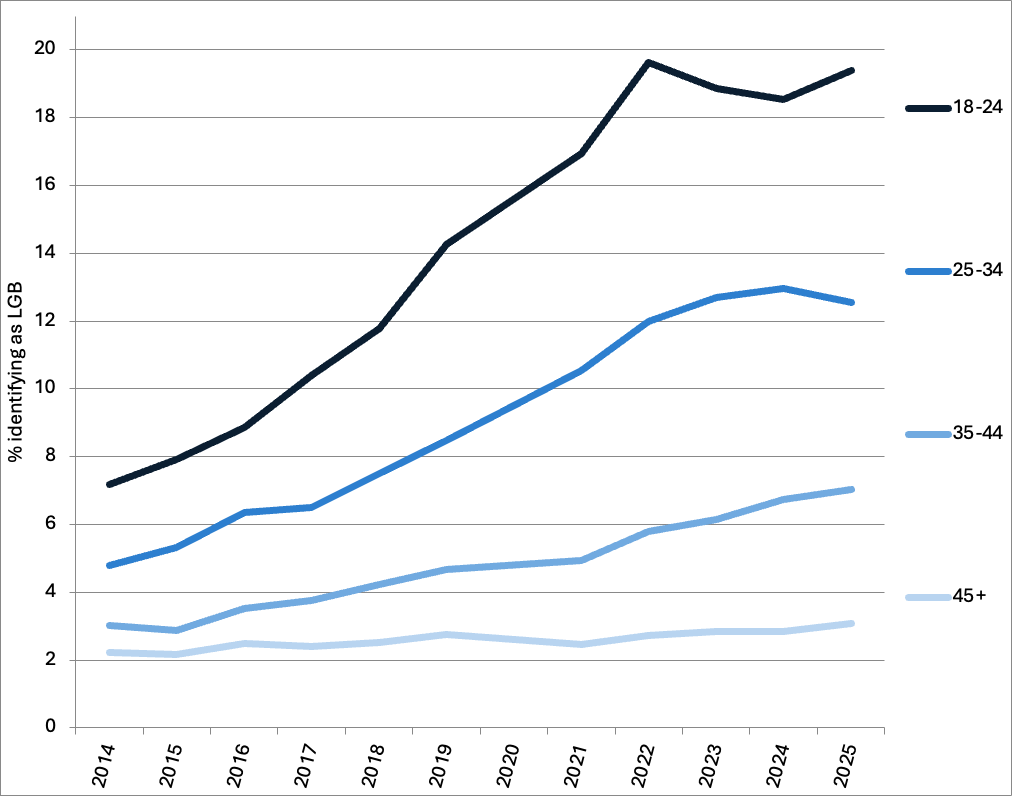
Figure 1: Identifying as lesbian, gay, or bisexual (LGB), by age group, U.S. adults, 2014-2025. Source: Behavioral Risk Factor Surveillance Survey. NOTE: 2020 data are excluded as data collection was paused for the pandemic. Survey year is interview year in the dataset, not the year of the datafile. Includes the full year of 2025 data. Analyzed by Jean M. Twenge for the Generation Tech Substack.
Among 25- to 34-year-olds, identifying as LGB also stabilized after more than doubling from 2014 to 2023. Rates continue to slowly rise among those over age 35; identifying as LGB was at all-time highs in 2025 among both 35- to 44-year-olds (7.02%) and those 45 and older (3.07%).
The uptick in identifying as LGB among 18- to 24-year-olds is completely driven by women (see Figure 2). There was a substantial increase in young women identifying as lesbian, which reached an all-time high in 2025 at 6.31% (the next highest was 4.94% in 2022). So more U.S. young women than ever are identifying as lesbian.
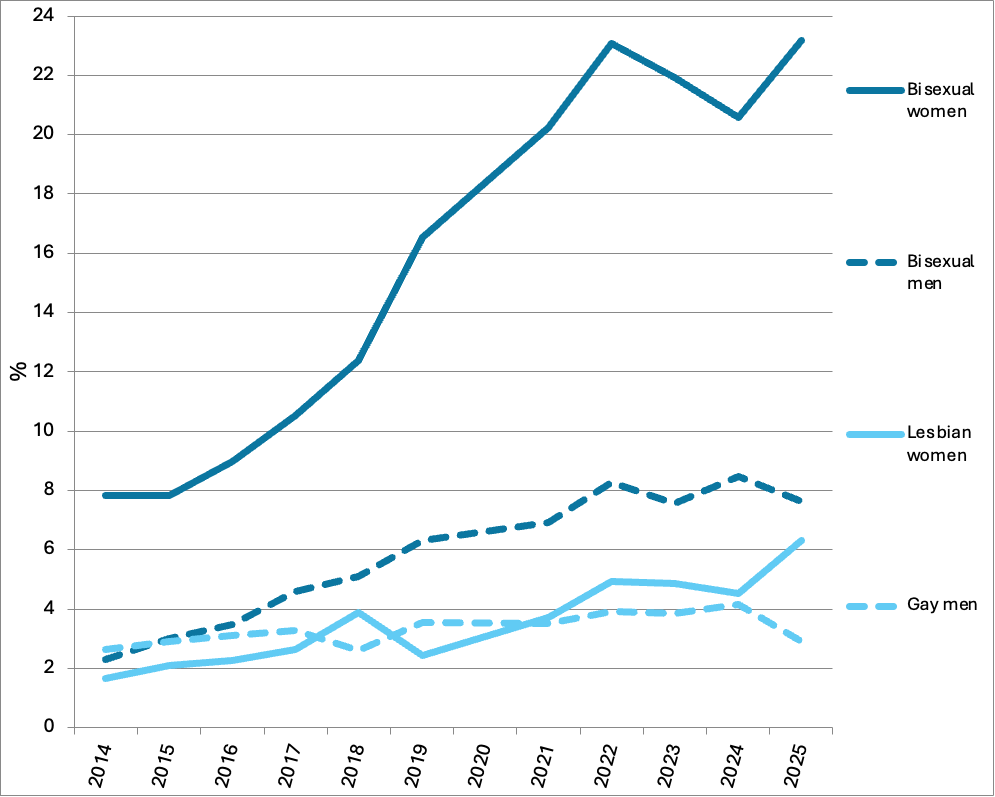
Figure 2: Identifying as lesbian, gay, or bisexual, by gender, U.S. adults ages 18 to 24, 2014-2025. Source: Behavioral Risk Factor Surveillance Survey. NOTE: 2020 data are excluded as data collection was paused for the pandemic. Survey year is interview year in the dataset, not the year of the datafile. Includes the full year of 2025 data. Analyzed by Jean M. Twenge for the Generation Tech Substack.
Young women identifying as bisexual also reached an all-time high in 2025, though not by as much (23.17%, compared to 23.08% in 2022).
What about 2026? Given how the early 2025 data looked different from the full year, I decided not to analyze the early 2026 data. The sample size for the first few months of 2026 is also too low, only 1,821 total and 117 who were 18 to 24 years old. The sample size for the whole year for 2025 on the sexual orientation item is also not what it should be: 78,343. That sounds like a lot until you compare it to the sample size for 2024 on this item, which was 250,040. Interestingly, the sample size drop was not as large for the other items on the survey, suggesting the 2025 survey purposely asked fewer people the sexual orientation question. Also, the question about identifying as transgender that was included in the 2014 to 2023 BRFSS surveys was absent from the 2025 datafile, as it was in 2024. So we don’t know whether identifying as transgender increased, decreased, or stayed the same after 2023 — the data are not there.
Here’s what we do know: Identifying as non-heterosexual did not decline in 2025 as we’d previously seen with data early in the year. Instead, the number of American young adults identifying as LGB stabilized after increasing precipitously between 2014 and 2022. However, identifying as bisexual and especially as lesbian is at all-time highs among young women in 2025. We’ll have to wait until next year to know for sure if this trend will continue into 2026.