

Late 2024 and early 2025 were a political turning point in the U.S. Trump was elected in November 2024 and took office in January 2025. Mass upheaval followed for government workers, grant funding, USAID, and many others. But the change was more than just politics; cultural attitudes shifted as well. For example, it suddenly became acceptable to publicly question puberty blockers for kids or transgender athletes in women’s sports. When given the chance, people questioned the idea that there were more than two genders.
The change wasn’t limited to attitudes about others. Fewer Americans identified as transgender or non-binary – even among kids as young as 13. Fewer identified as non-heterosexual, with an especially large decline in bisexual identity.

We still have very little data from 2025, though, given the delays in datasets becoming publicly available. In an earlier post, I found that fewer young adults, especially women, identified as bisexual in 2024 and early 2025 compared to earlier years. The change wasn’t large, though, and for men only appeared in the data from 2025, which was collected at the very beginning of the year as part of the Behavioral Risk Factor Surveillance System (BRFSS) and was included in the 2024 datafile. We don’t have the 2025 datafile for the BRFSS and won’t until August.
But we do have data from April and June 2025 from the Household Trends and Outlook Pulse Survey, a continuation of the Household Pulse Survey collected by the Census Bureau from April 2020 to September 2024. Household Pulse asked about sexual orientation beginning in July 2021. Beginning in late July 2024, they changed the “other” response from “Something else” to “I use a different term.” So we’ll compare July-September 2024 to June 2025, all times whe the sexual orientation question was asked in the same way. (I included only June to get the most recent data; it’s also not clear if the April and June datafiles are the same people since the design transitioned to longitudinal).
What does this data show?
The short answer: Big changes. From summer 2024 to June 2025, the number of 18- to 29-year-olds identifying as non-heterosexual (gay, lesbian, bisexual, or other) dropped from 30% to 18% -- close to half (see Figure 1). Among 30- to 39-year-olds, they dropped from 17% to 12%. There were smaller changes among those in their 40s and those 50 and older.
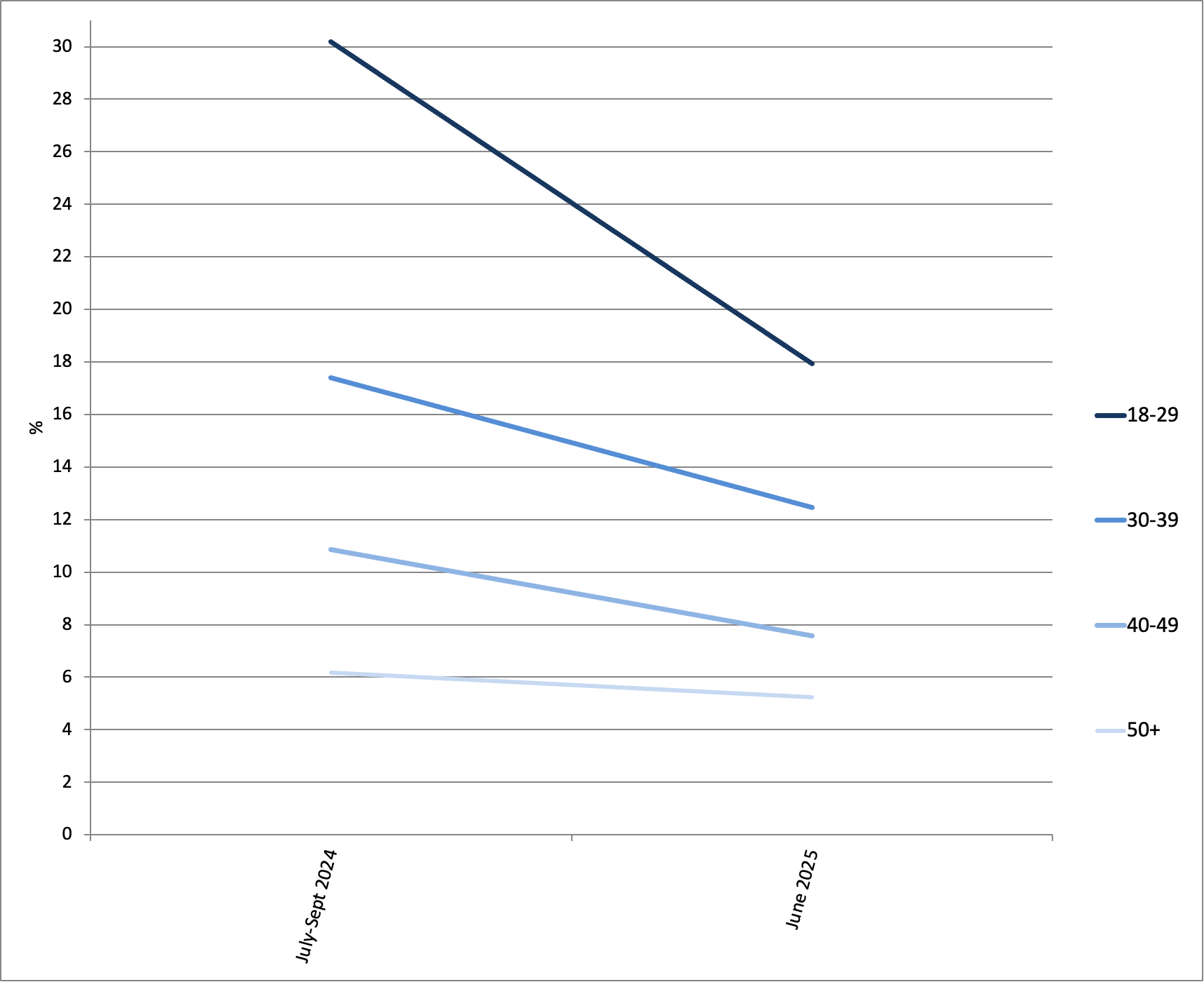
Figure 1: Percent identifying as non-heterosexual, by age group, summer 2024 vs. June 2025. Source: Household Pulse Survey, U.S. Census Bureau. Data are not weighted.
For young adults (18-29), the declines were largest among bisexuals, going from 24% to 12% among women and from 11% to 5% among men (see Figure 2). The number of young women identifying as lesbians dropped from 5% to 2%. There was little change in identifying as gay among young men.
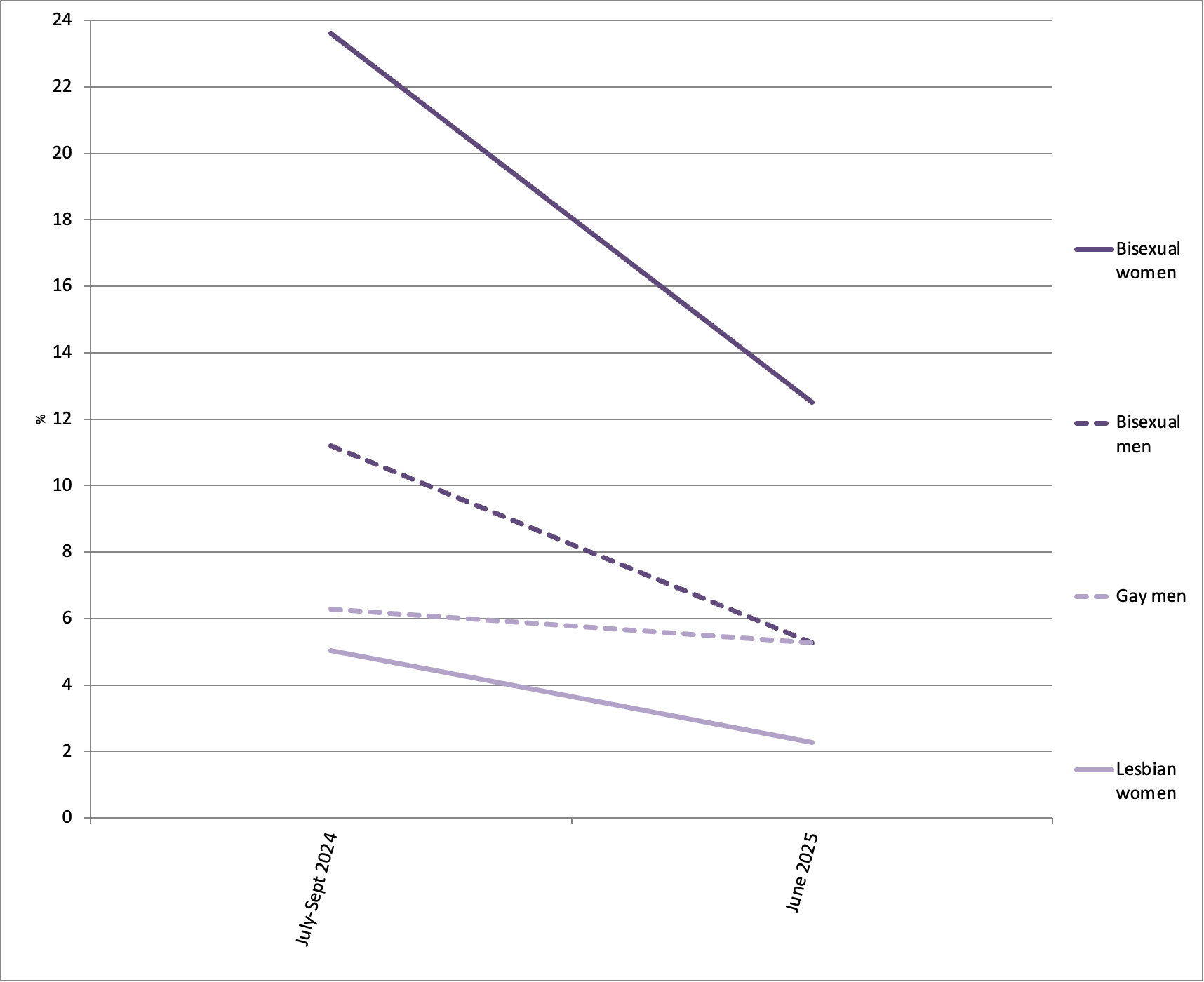
Figure 2: Percent of 18- to 29-year-olds identifying as bisexual, gay, or lesbian, by sex, summer 2024 vs. spring 2025. Source: Household Pulse Survey, U.S. Census Bureau. Data are not weighted.
These declines are much larger than those in the BRFSS from 2024 to early 2025.
Why were the changes here so big? There are a few possibilities.
First, it’s possible that at least some of the declines are due to sampling (that is, due to who’s in the survey vs. a real change at the population level). The 2025 Household Pulse survey was redesigned to be longitudinal (following people over several surveys). That may have meant a different type of sample even though the rest of the survey procedure was the same as in 2024. However, the pattern of change, with the largest declines among the youngest age group and among bisexual women, is exactly the same as in the BRFSS, which doesn’t have this issue. It’s also interesting that there’s very little change in identifying as gay among young men, but large changes in identifying as bisexual among women. If there were a sampling change one would expect it to impact all groups equally, or at least not this differently.
Second, the cultural and political shift between summer 2024 and spring 2025 may have made LGB people more reluctant to be truthful about their sexual orientation on government surveys. That might be particularly true as the 2025 surveys transitioned to a longitudinal design with people filling out multiple surveys over the course of months. However, it’s not clear why that would impact younger adults and bisexuals more and gay men and those over 50 hardly at all.
Third, this could represent actual change in people’s identities and behavior. The June 2025 data were collected about 5 months later than the early 2025 BRFSS data, well into Trump’s second term and the resulting cultural shift. The large changes in identifying as bisexual among women from 2014 to 2023 suggests a cultural change; the decline may also be a cultural change. There is some preliminary evidence that women are not having sex with women as much as they used to, a behavioral indicator that also points toward a true change rather than an artifactual one.
We’ll know more once the BRRSS data for 2025 is released. For now, it’s looking more and more likely that fewer young adults are identifying as bisexual.