

There are now seven living generations: Silents, Boomers, Gen X, Millennials, Gen Z, Alphas, and Betas. Why so many? Two reasons: First, people are living longer, and second, generations are turning over faster than they used to due to the breakneck pace of technology.
The co-existence of so many generations makes it even more important that we recognize what the real differences between generations are – not so we can point fingers, but so we can understand each other better.
This was what I talked about with Oprah on her new online show, based on my book, Generations: The Real Differences between Gen Z, Millennials, Gen X, Boomers and Silents—and What They Mean for America’s Future. (The book is my magnum opus, summarizing my research on generational differences and why generations exist, along with some fun stuff like pop culture memories and list of the famous members of each generation).
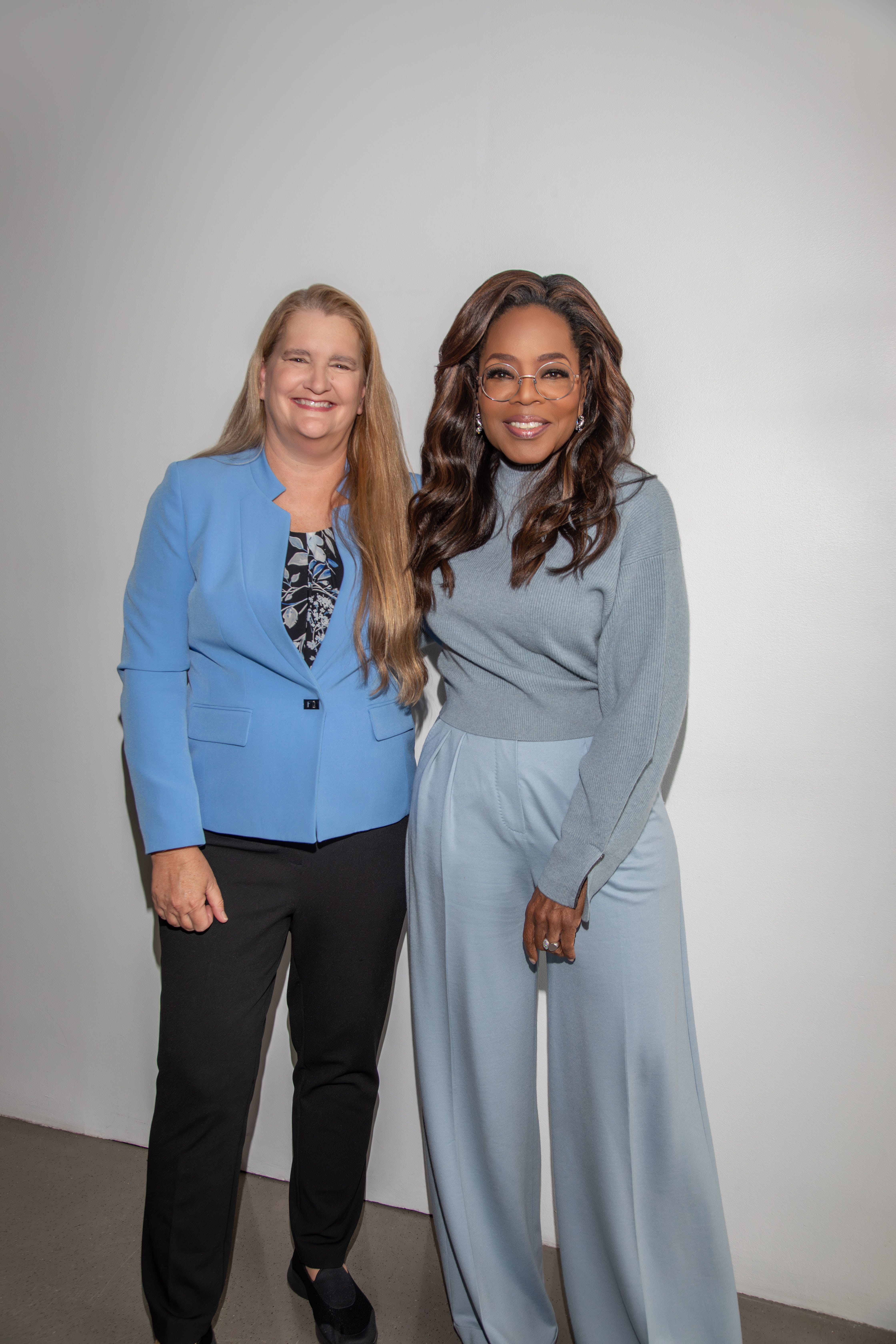
I’ll cover two primary topics in this post: 1. What generational differences are people most interested in? and, just as interesting, 2. You really met Oprah? What is she like?
The show was taped in an event space at a high rise in Manhattan, with the studio on an upper floor and the dressing rooms and overflow space on a lower floor. There was a studio audience with other featured guests sitting in the front row, including a woman who makes hilarious videos about being middle-aged (she’s got glasses on her face, on the top of her head, and on her shirt front), a young man who posted a TikTok video about being a Gen Z worker (and why they stare at us), and Amanda Schneider, who wrote a book about workplace culture (we did a fun podcast later, too). I sat next to Oprah on the small stage, with large podcast-style microphones in front of us.
The show was fast-paced and covered a lot of ground. Some of what we talked about:
• The Gen Z stare – in depth. My favorite moment was when a young man (Demetrius) explained the Gen Z stare, which happens when a Gen Z worker just looks someone blankly instead of answering a question or making small talk. Some Gen Z’ers say they do this when a customer asks a dumb question or when, especially in a service job, they are burned out on showing positivity. When a customer asks something like “Can I get a cheeseburger with no cheese?” Demetrius explained, they stare because “It takes us a second to kind of maybe buffer it.” That instantly made me think of a phone or a website that’s loading, with the round icon that spins. “Like your brain is doing this,” I said, moving my finger in a circle. His eyes lit up. “Like loading – literally loading,” he said. What he said next was even more interesting: “We don’t see work as something that’s enjoyable, especially with influencers making tons of money just doing whatever.” And it’s true – Gen Z is less likely to say they expect their chosen work to be satisfying than previous generations did at the same age. And with only a tiny minority able to make a living as influencers, everything else seems boring and like too much work in comparison.
• Work attitudes. There are lots of rumors out there about generational differences in the workplace – that Gen Z only wants jobs that are interesting and meaningful, that they don’t want to work as many hours, that they will start crying when faced by negative feedback. A lot of it is hard to study, especially since any survey of workers done a single time can’t separate age from generation. If Gen Z workers say they want jobs that are interesting, maybe that’s because they are younger, not because of a generational difference. And apparently it is: In a survey that’s been done every year since 1976, Gen Z 18-year-olds were less likely to say they wanted a job that was interesting compared to Boomers and Gen X’ers when they were 18. The biggest generational difference is instead in work-life balance: Especially post-pandemic, Gen Z is less likely to say they are willing to work overtime and less likely to say that they expect work to be a central part of their lives (see Figure).
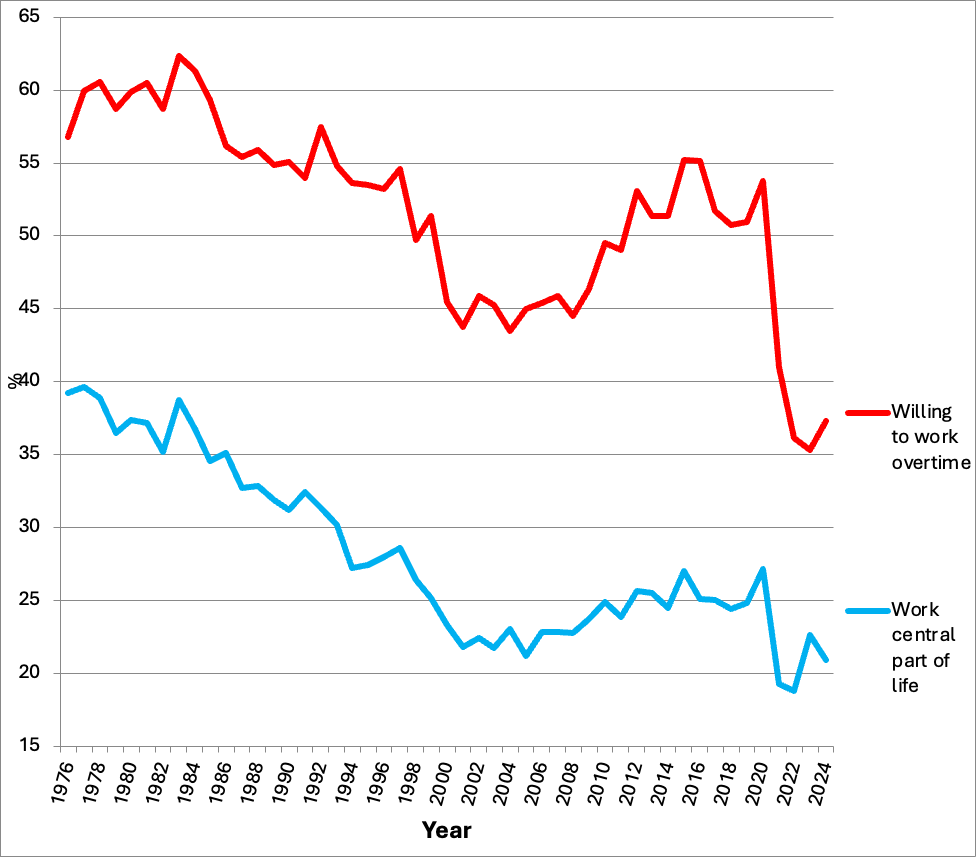
Figure: Percent of U.S. 12th graders willing to work overtime to do a good job and percent agreeing work will be a central part of their life, 1976-2024. Source: Monitoring the Future. Analyzed by Jean Twenge for the Generation Tech Substack.
• The slow life strategy. With people living longer, the entire developmental trajectory has slowed down: Kids are less independent, teens are less likely to have a driver’s license or a job, young adults marry and have kids later, and middle-aged people look and feel younger than their parents or grandparents at the same age. Thinking about these generational shifts through this lens helps in a few ways. First, it helps us see these trends aren’t due to economic shifts. That means they’re probably not going to change anytime soon. Second, it helps us understand each other better and maybe even criticize less. Young people are not necessarily immature or “failing to launch” – they are just taking longer to grow to adulthood, just as their parents are taking longer to feel old. This theory does the best job of explaining all of these trends, including why teens aren’t as interested in driving as they used to be.
• Dating and relationships. Some of Gen Z’s delay around dating and sex is because of the slow life strategy – but not all of it. There’s also a gap in social skills, and meeting people to date is the ultimate test of social skills because much of the interaction is unspoken rather than said directly. And if you’re not getting together in person with friends or going to parties, you’re not going to meet as many people. The rise of dating apps and concern around sexual harassment has also shifted the cultural norm around approaching potential dates. Elsbeth Wimpy, one of the featured guests, interviewed Gen Z’ers about dating and concluded that for young men, “approaching a woman is just weird now.”
• Partying Boomers. Everyone got used to older people being Silents, who married young in the 1950s and early 1960s and never did drugs. Boomers smoked a lot of pot when they were young, and they are continuing to smoke a lot of pot now that they’re older; there’s a graph in Generations showing the huge increase in marijuana use among people in their 60s as the group transitioned from Silents to Boomers. Boomers are also continuing the era of sexual liberation they ushered in when they were young, partially because many of them ended up divorced. When Oprah asked me what was going on, I said, “The Boomers had free love in the 1960s, and now they have free love in their 60s.” I came up with that on the fly, surprising even myself – I always include a lot of humor in my talks, but it’s mostly prepared ahead of time rather than improv.
So what is Oprah like? When we went back downstairs after the show, she discovered that a group of high school students and their teacher hadn’t been able to get seats in the taping room, so they’d watched the show from the overflow room. Oprah spent about 15 minutes talking to them – all off-camera and not something she was at all obligated to do. I could see the delight on the teens’ faces.
When Oprah and I talked backstage before the show, she commented to one of her staffers, “I wore blue because Jean wore blue.” (Faint). As we entered the taping, she held my hand. She talked a lot about her TV talk show that ran from 1986 to 2011, and it sounded like she missed those days. I thought about what that must be like for her, and for anyone who does something huge and then retreats because it’s so all-encompassing it’s beyond exhausting … because then what do you do next? And how do you fill that space in your life?
Not surprisingly, Oprah is an extremely skilled interviewer and host. She diffused the nervous energy in the space (OMG, I’m in a room with Oprah!) and before long we were all laughing. When I wanted to say something but didn’t want to interrupt the flow, she signaled me with her eyes that she’d get to me. She asks follow-up questions to understand what’s really going on, and isn’t afraid to disagree or challenge.
Working with the show’s producers in the weeks leading up to the taping, I noticed something: They called her Ms. Winfrey, not Oprah. It almost felt like the more formal title was a sign of closeness: The world knows her as Oprah, but to her staff she’s Ms. Winfrey. It captures the delicate balance she’s struck throughout her career, between being the consummate professional and being emotionally close to her audience.
In Generations, I used Oprah’s career as an example of the impact of the Boomer generation, who lived the changes brought by the Silent-led civil rights and women’s movements and declared that nothing was off-limits for discussion. Oprah was at the forefront of this new openness, showing it was OK to talk about what used to be taboo, like cancer, menopause, and sexual abuse. She brought that same approach to talking about generations on the show, with people of different generations sharing their experiences. You can check it out here.